Early Spay/Neuter May Raise Your Dog’s ACL Risk

Can Early Spay or Neuter Increase Your Dog’s ACL Injury Risk?
Yes, early spay or neuter may increase your dog’s risk of ACL injury, also called a cranial cruciate ligament tear.
The recommendations around when to spay or neuter dogs have changed dramatically.
A large study involving over 20,000 dogs found that spaying a female dog before age 3 and neutering a male dog before age 2 dramatically increased the risk of ACL injury.
That is a big shift from the old blanket advice many of us were taught: spay or neuter at 6 months.
I did thousands of early spays and neuters, especially when I worked with animal shelters. At the time, it made sense. We were trying to prevent pet overpopulation.
But now we are seeing evidence that removing sex hormones too early can affect bone, muscle, soft tissue, ligament strength, immune health, and long-term disease risk.
If you have a puppy, this is something you need to know before making the decision.
Dr. Jones’ Undenatured Type 2 Collagen Joint Care Chews for Dogs




What Is the ACL in Dogs?
ACL stands for anterior cruciate ligament.
In dogs, it is also commonly called the cranial cruciate ligament.
This is one of the primary ligaments that stabilizes the knee, also called the stifle joint.
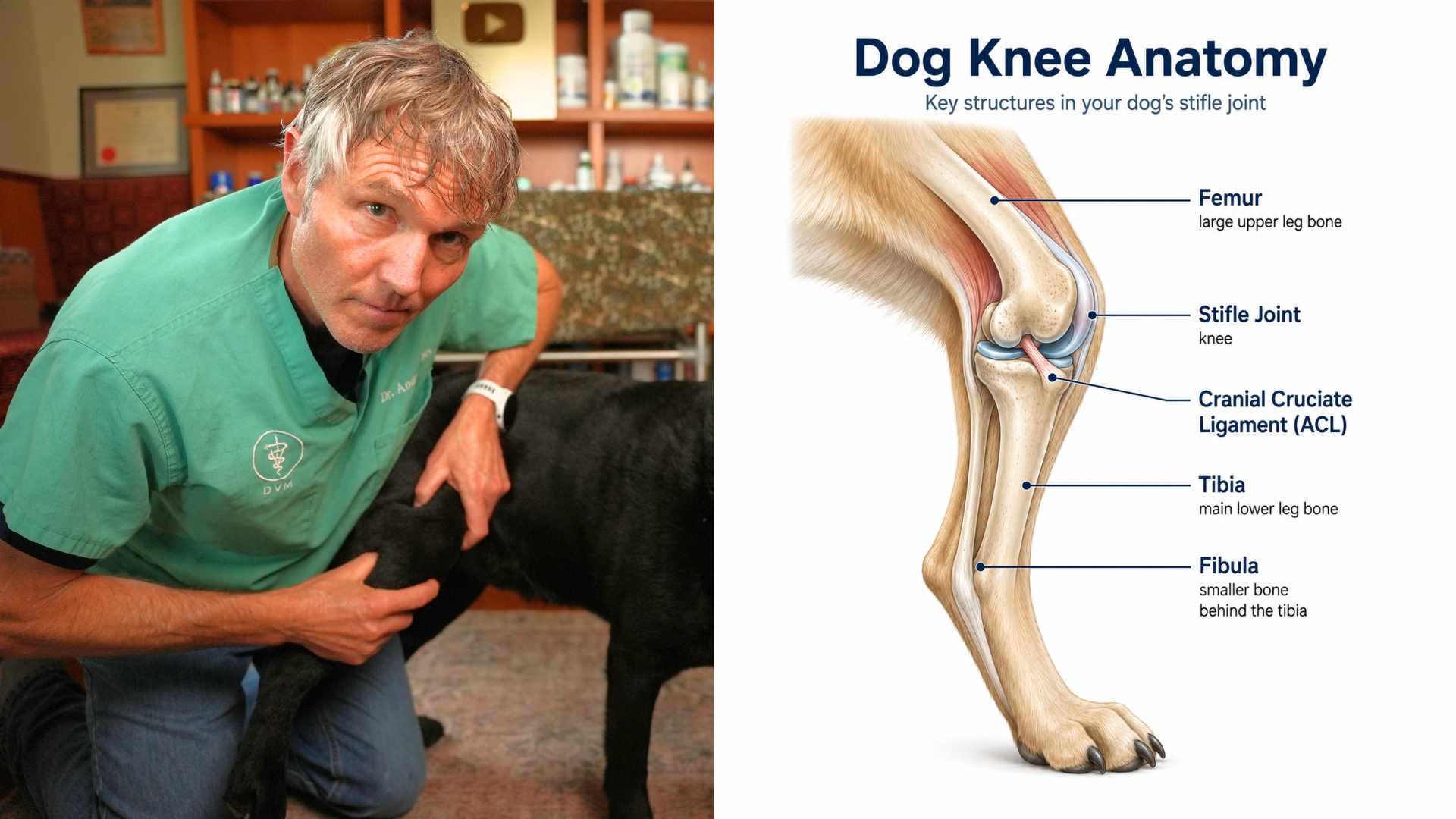
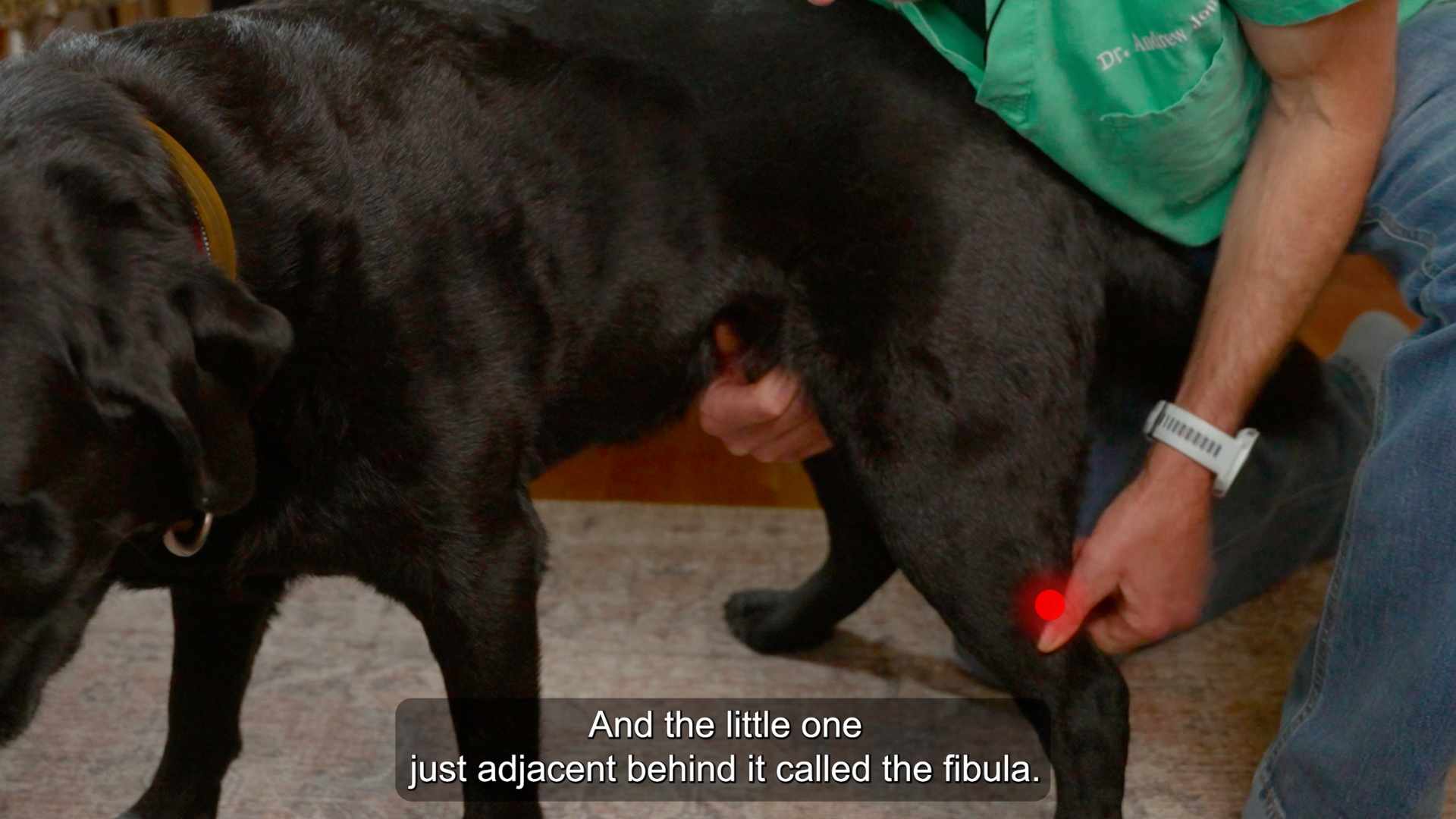
Your dog’s knee is made up of several key structures:
- Femur, the large upper leg bone
- Tibia, the main lower leg bone
- Fibula, the smaller bone behind the tibia
- Stifle joint, or knee
- Cranial cruciate ligament, also called the ACL
The ACL runs from the femur down across the knee and attaches to the tibial plateau.
Its job is to keep the knee stable when your dog flexes, extends, runs, jumps, turns, or plays.
Basically, it keeps the knee from sliding forward in a way it should not.
Useful little ligament. Expensive little ligament when it tears.
What Happens When a Dog Tears the ACL?
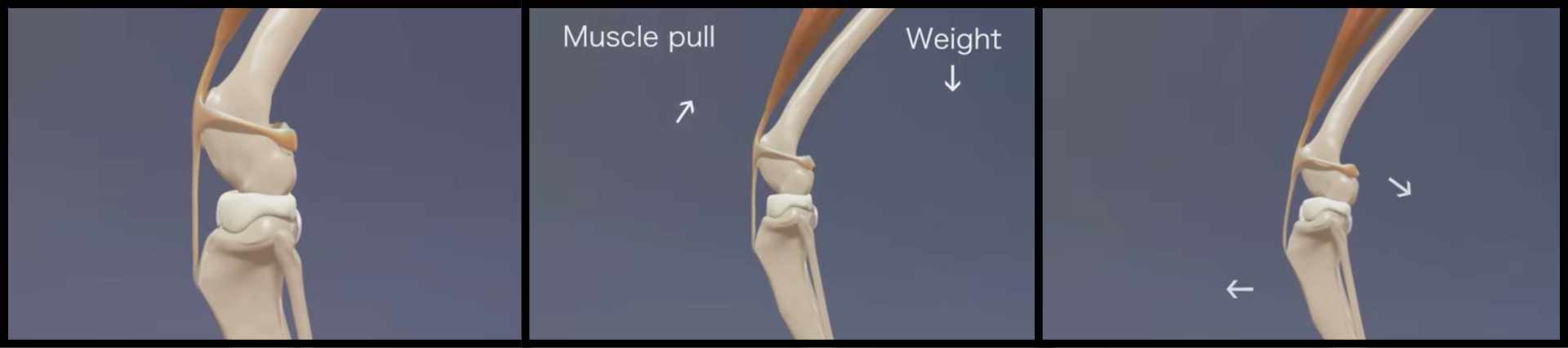
When the ACL tears, the knee becomes unstable.
Your dog may suddenly limp, hold up the leg, have trouble standing, or show pain in the knee.
One common exam test is called the cranial drawer sign. This is where the upper and lower parts of the knee are held firmly, and the lower bone, the tibia, is checked to see if it moves forward in relation to the femur.
There should be no forward motion.
If there is forward motion, that can suggest an ACL rupture.
Sometimes, when flexing and extending the knee, there may also be an audible click. That can suggest a possible meniscal injury along with the ACL tear.
Why Are ACL Tears Such a Big Deal?
ACL injuries are common, painful, and often expensive.
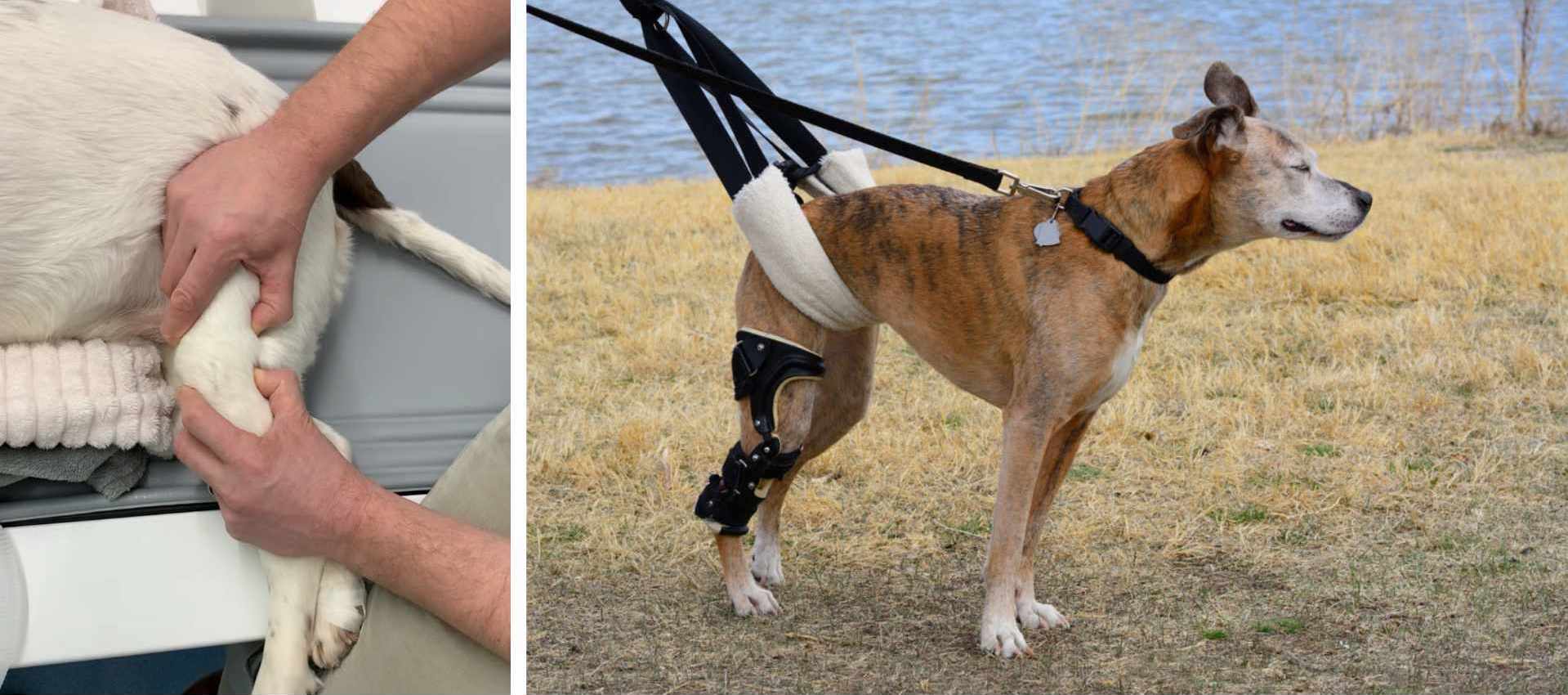
There has been what I would call an epidemic of dogs rupturing their ACLs.
Many of these injuries require surgery, and some advanced procedures can cost well over $10,000, often at referral practices.
But the cost is not the only problem.
Even after surgery, a dog may not have a fully normal knee.
Dogs with ACL tears are more prone to:
- Early degenerative joint disease
- Ongoing lameness
- Knee stiffness
- Reduced mobility
- Chronic pain
- Meniscal injury
- Future arthritis
Sometimes surgery works very well.
But not always.
So if there is something we can do early in life to lower the risk, especially around the timing of spay or neuter, it is worth paying attention.
What Did the Newer Research Show?
The source content discussed several studies.
Large Study of Over 20,000 Dogs
A large study involving over 20,000 dogs found that:
- Spaying female dogs before age 3 dramatically increased ACL injury risk.
- Neutering male dogs before age 2 dramatically increased ACL injury risk.
That is much later than many pet parents were previously told.
2024 University of Wisconsin-Madison Study
A 2024 study at the University of Wisconsin-Madison found that dogs neutered before 12 months of age had a marked increase in ACL injury risk.
This was seen even in dogs without a prior genetic predisposition.
In other words, this was not only about breed lines already known for ACL problems.
The early spay or neuter itself appeared to be a major external risk factor.
February 2024 Ohio State Study
A February 2024 study from Ohio State looked at over 4,000 agility dogs.
They found that early spay and neuter strongly increased the risk of stifle, or knee, injury.
More than half of those knee injuries were ACL tears.
2022 UC Davis Study
A 2022 UC Davis study found that spayed female dogs had a markedly increased risk of ACL injury compared with non-spayed female dogs.
That study also looked at other health concerns, including cancer risks in different dog breeds.
The larger takeaway was the benefit of delaying the age at which dogs are spayed or neutered, if they are spayed or neutered at all.
Why Would Early Spay or Neuter Affect ACL Risk?
Sex hormones are not only about reproduction.
They are important for normal growth and development.

They affect:
- Bone growth
- Muscle development
- Soft tissue strength
- Joint stability
- Ligament support
- Immune function
- Normal cell growth
When sex hormones are removed too early, the bones, muscles, and soft tissues may not develop in the same balanced way.
Imagine a dog whose bones keep growing, but the muscles and soft tissues do not develop in the same strong, supportive pattern.
You may end up with a dog who is more straight-legged, has less soft tissue support, and has a knee that is not as stable as it should be.
That instability can increase the risk of ACL injury.
Why Did We Spay and Neuter So Early?
The main reason was pet overpopulation.
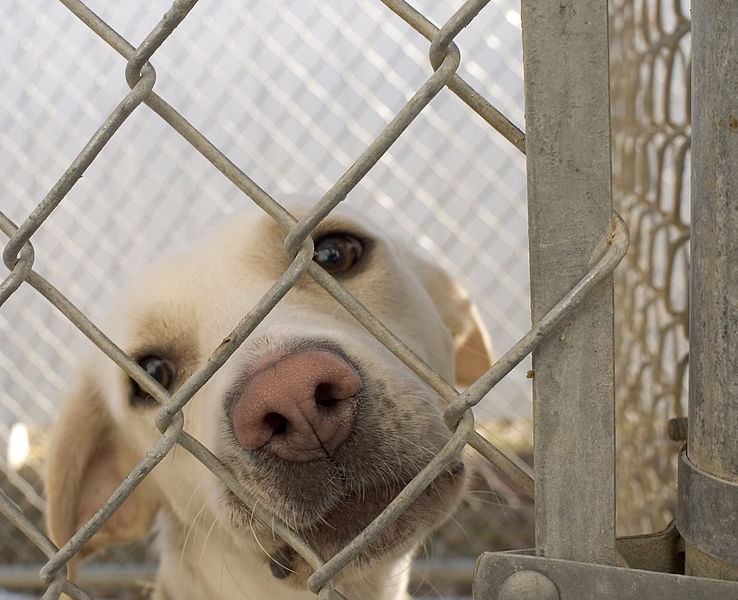
The thinking was simple:
“We do not want unwanted puppies and kittens, so let’s spay and neuter early.”
And honestly, in a shelter setting, that made sense.
I was involved with animal shelters, and we were aggressive about early spay and neuter because we did not want more puppies and kittens.
Fair enough.
But at the time, there was not enough thought given to how early hormone removal could affect long-term health.
Now, in hindsight, we are seeing that early spay and neuter may have consequences.
And ACL injury is one of the big ones.
Why Sex Hormones Matter Beyond Reproduction
Sex hormones help guide the body as it develops.
They affect far more than fertility.
They appear to play a role in:
- Musculoskeletal development
- Ligament strength
- Joint stability
- Immune system balance
- Possibly cancer risk
- Overall growth patterns
When we remove those hormones too early, we may change how the dog’s body grows.
The intention was good: prevent overpopulation.
But blanket advice can create problems when it does not consider individual dogs, breed differences, age, size, health risks, and long-term consequences.
When Should You Spay or Neuter to Lower ACL Injury Risk?
Based on the source content, the newer recommendations suggest delaying.

Suggested Timing From the Source Content
| Dog | Timing to Consider |
|---|---|
| Female dogs | Closer to 3 years of age |
| Male dogs | Up to 2 years of age |
This is very different from the old 6-month advice.
It does not mean every dog must follow one exact rule.
But it does mean pet parents should ask questions before agreeing to early spay or neuter.
What Are the Alternatives to Traditional Spay and Neuter?
One option is to delay spay or neuter.
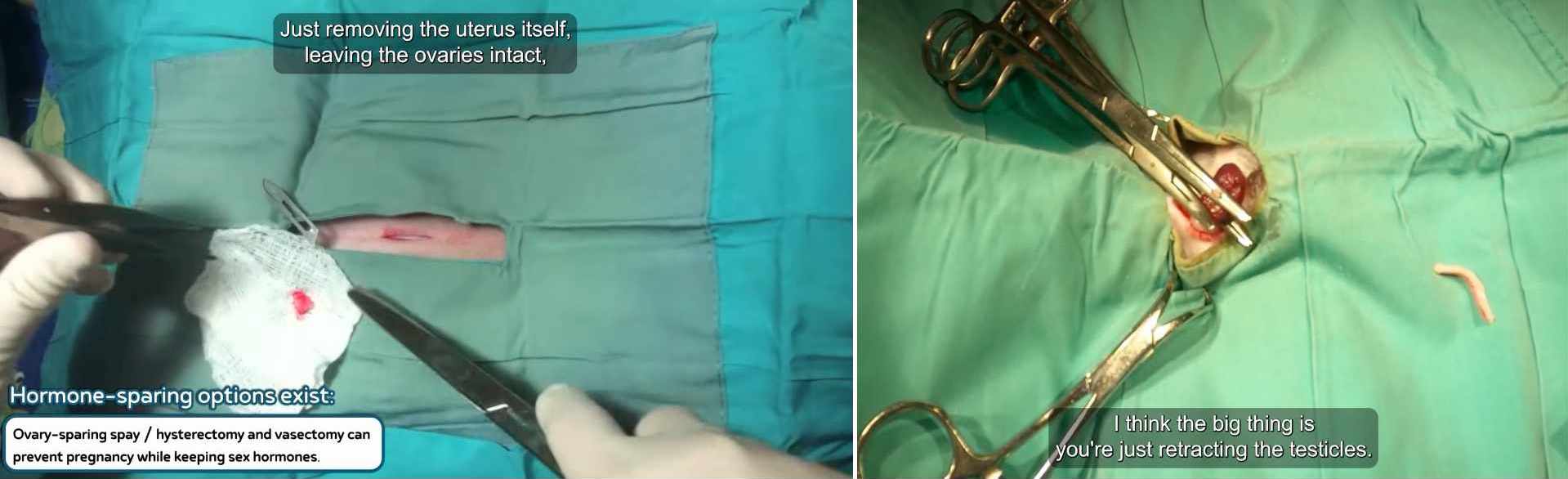
Another option is to use hormone-sparing sterilization.
This means the dog is sterilized, but the hormone-producing organs are left intact.
For Female Dogs: Hysterectomy
Instead of an ovariohysterectomy, which removes the ovaries and uterus, a hormone-sparing option is a hysterectomy.
This means removing the uterus while leaving the ovaries intact.
The ovaries continue producing sex hormones.
This allows the dog to keep the hormonal benefits while preventing pregnancy.
For Male Dogs: Vasectomy
Instead of removing the testicles, a male dog can have a vasectomy.
The testicles remain, so testosterone is still produced.
The dog is sterilized, but the hormones remain.
This is similar in concept to what is done in human males.
Why Not Just Do a Tubal Ligation in Female Dogs?
Some people ask about tubal ligation, which is done in people.
The concern in dogs is pyometra.
Pyometra is a serious uterine infection.
The source content notes that the risk can be high, up to 25%.
That is why, if this were my dog, I would choose a hysterectomy instead of a tubal ligation.
The uterus, including the cervix, should be removed.
You do not want to leave part of the cervix or lower uterus, because that can still result in pyometra when the ovaries continue producing hormones.
What Happens if the Ovaries Are Left Intact?
If the ovaries remain, the dog still produces ovarian sex hormones.
That means she may still experience heat cycles.
But because the uterus is no longer intact, there should not be the same estrus bleeding.
She may still attract attention from male dogs a couple of times a year.
That is something pet parents need to manage.
But if keeping those hormones lowers the risk of ACL injury and other serious diseases, I think it is worth considering.
What About Male Dogs and Testosterone?
For male dogs, leaving the testicles intact means testosterone is still produced.
That can be a concern if you have a dog with serious aggression issues.
But in many cases, behavior should be addressed with proper training, management, and behavior work, rather than assuming the best solution is removing all testosterone.
Testosterone also has benefits.
It supports muscle development and other body systems.
Anyone who has dealt with declining testosterone can understand the question:
“Where did my muscles go?”
Hormones matter.
What About Mammary Tumors?
One of the classic reasons given for spaying female dogs early was lowering the risk of mammary tumors.
That was something I discussed many times in practice.
The source content notes that the risk is still actually quite low, and the benefits of keeping intact sex hormones may markedly lower the risk of other conditions, including ACL injury and some cancers.
So this becomes a more balanced discussion.
It is not just:
“Spay early because mammary tumors.”
It is:
“What are the risks and benefits for this individual dog?”
That is the discussion pet parents should be having now.
What Is the Parsemus Foundation?
The Parsemus Foundation is mentioned in the source content as a resource for pet parents and veterinarians.
They provide information on hormone-sparing sterilization options, including:
- Ovary-sparing procedures
- Hysterectomy
- Vasectomy
- Hormone restoration therapy
These procedures may be newer for many veterinarians, and not every clinic offers them.
If I were still in practice, vasectomy would be a new procedure for me to learn.
But thousands of vasectomies and hysterectomies have been performed, with the testicles or ovaries left intact so hormones continue to be produced.
Traditional Spay/Neuter vs Hormone-Sparing Options
| Procedure | What Is Removed | Hormones Preserved? | Pregnancy Prevented? |
| Traditional spay, ovariohysterectomy | Ovaries and uterus | No | Yes |
| Hysterectomy | Uterus, including cervix | Yes, ovaries remain | Yes |
| Traditional neuter | Testicles | No | Yes |
| Vasectomy | Vas deferens is interrupted | Yes, testicles remain | Yes |
| Tubal ligation | Fallopian tubes interrupted | Yes | Yes, but pyometra risk remains |
What Dogs May Be at Higher Risk for ACL Tears?
The source content mentions that Labradors are definitely higher risk for ACL tears.
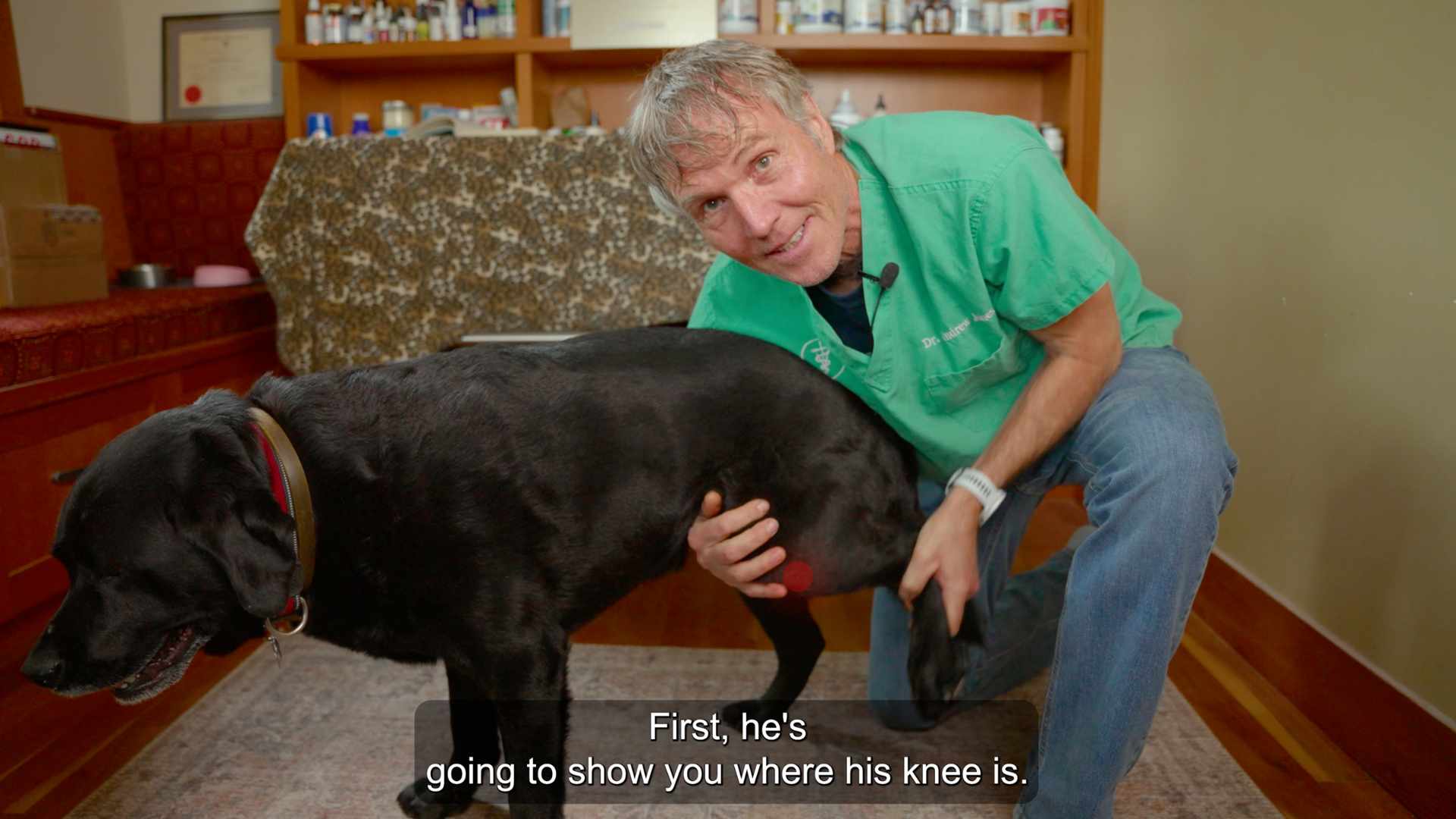
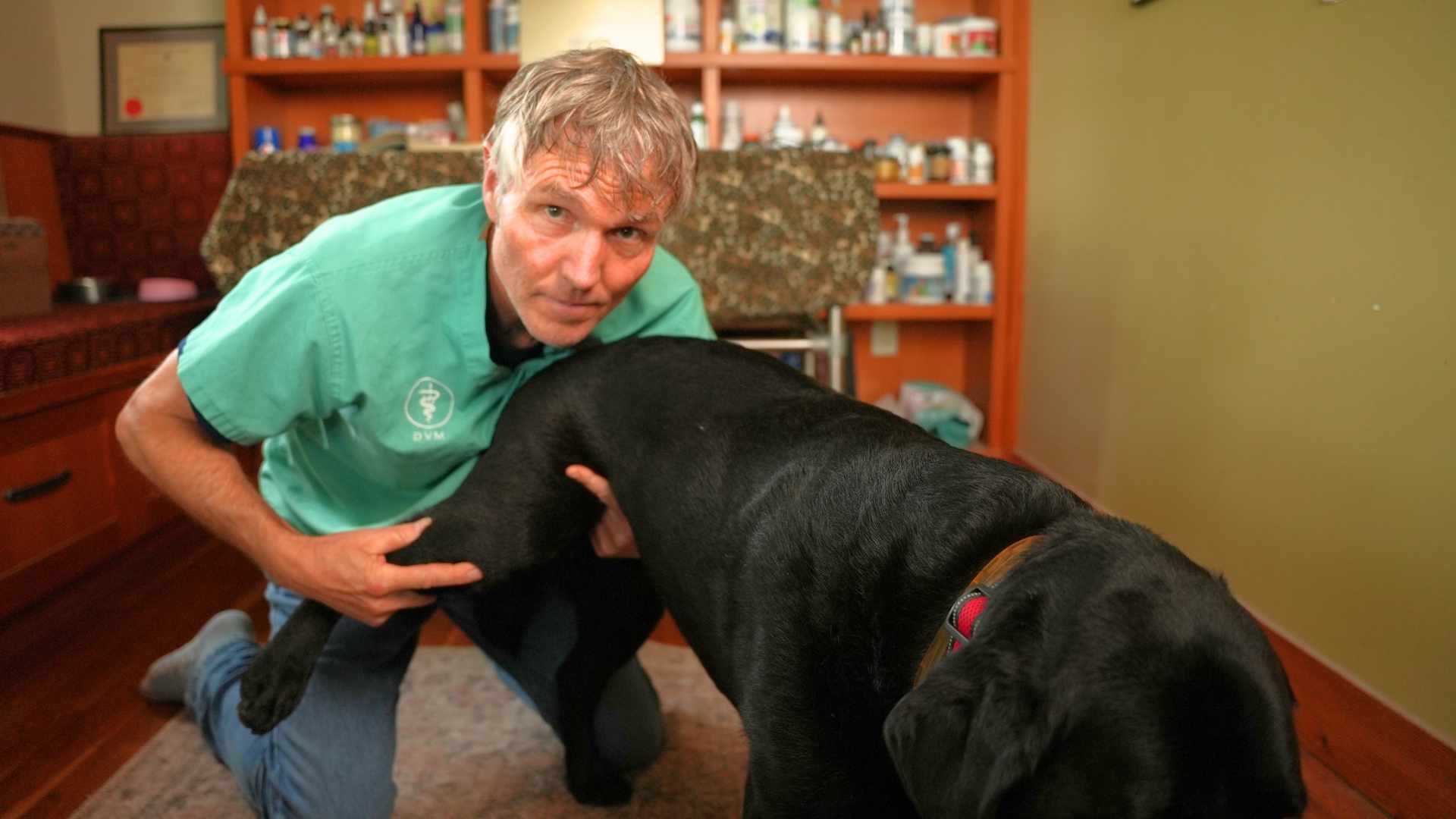
Angus, the model dog in the video, is a Lab, and thankfully his knee felt solid with no evidence of ACL injury.
But ACL injuries can happen in many breeds.
Risk may be influenced by:
- Breed
- Genetics
- Early spay or neuter
- Hormone removal
- Joint structure
- Muscle development
- Activity level
- Knee stability
The key point from this discussion is that early spay and neuter appears to be one of the major modifiable risks.
Best For
Delaying spay or neuter, or considering hormone-sparing sterilization, may be especially worth discussing for:
- Puppies
- Large-breed dogs
- Female dogs under 3 years old
- Male dogs under 2 years old
- Dogs at higher risk of ACL injury
- Active dogs
- Agility dogs
- Labradors and other breeds prone to knee injuries
- Pet parents concerned about long-term joint health
- Pet parents interested in hormone-sparing options
Pros and Cons of Delaying Spay or Neuter
Pros
- May lower ACL injury risk
- Allows hormones to support growth and development
- May support better muscle and soft tissue development
- May reduce risk of certain long-term health issues
- Gives the dog more time to mature before hormone removal
Cons
- Requires responsible management
- Females may go through heat cycles
- Intact males may need behavior management
- Not every veterinarian offers hormone-sparing options
- Pet parents must prevent unwanted breeding
- Timing may vary by dog, breed, and situation
Pros and Cons of Hormone-Sparing Sterilization
Pros
- Prevents pregnancy
- Preserves sex hormones
- May help lower ACL injury risk
- May support normal growth and development
- May offer long-term health benefits
- Provides an option beyond traditional spay or neuter
Cons
- Not every veterinarian performs these procedures
- Some vets may need additional training
- Females may still attract males during heat cycles
- Behavior still needs to be managed
- Hysterectomy must remove the uterus and cervix to reduce pyometra concern
- More pet parent education is needed
Step-by-Step: What I Would Do Before Spaying or Neutering a Puppy
Step 1: Do Not Assume 6 Months Is Best
The old blanket rule of spay or neuter at 6 months should be questioned.
Ask whether that timing is right for your dog.
Step 2: Consider Your Dog’s Sex and Age
Based on the source content:
- Female dogs may benefit from waiting closer to 3 years.
- Male dogs may benefit from waiting up to 2 years.
Step 3: Consider Breed and Activity
Large breeds, active dogs, agility dogs, and breeds prone to ACL injuries deserve extra thought.
Step 4: Ask About Hormone-Sparing Options
Ask your veterinarian about:
- Hysterectomy for female dogs
- Vasectomy for male dogs
- Ovary-sparing options
- Whether they know a veterinarian trained in these procedures
Step 5: Manage Pregnancy Risk Responsibly
If you delay spay or neuter, or choose hormone-sparing options, you must prevent unwanted breeding.
That part still matters.
Step 6: Make an Individual Decision
Do not make this decision based only on habit.
Make it based on your dog’s health, breed, risk factors, your ability to manage them, and your veterinarian’s guidance.
Final Thoughts
Early spay and neuter may raise your dog’s risk of ACL injury.
That is not something I was taught years ago.

I wish I had known this 15 or 20 years ago, because I did a lot of early spays and neuters. At the time, the goal was to prevent pet overpopulation, and that made sense.
But now we are learning more.
Sex hormones are not just about reproduction. They affect growth, muscle, soft tissue, joints, the immune system, and long-term health.
For many female dogs, waiting closer to 3 years may be worth considering.
For many male dogs, waiting up to 2 years may be worth considering.
And for pet parents who want sterilization without removing hormones, hysterectomy and vasectomy are options to learn about.
The goal is not to blame anyone for past advice.
The goal is to learn and do better for the next dog.
Click To Get A Free Copy of My E-Book!

P.S. If you have a puppy, please do not treat spay or neuter timing like a default appointment at 6 months.
Ask questions.
For female dogs, waiting closer to 3 years may help lower ACL injury risk.
For male dogs, waiting up to 2 years may help lower ACL injury risk.
And if pregnancy prevention is the goal, ask about hormone-sparing options such as hysterectomy or vasectomy.
Your dog’s sex hormones are not just there for reproduction.
They help build the body your dog has to live in for the next 10 to 15 years.
That knee ligament is counting on you.