Dog Worms: How To Quickly Treat Them With Natural And Conventional Options
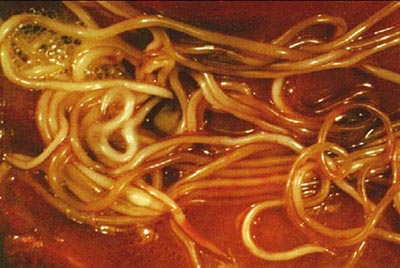
Worms in dogs are very common, with up to 1/3 of all dogs being infected with intestinal parasites; roundworms, tapeworms, coccidia and giardia. In this article, I’ll go over the most common types of worms, and how you can tell if your dog has worms. I’ll then go on to show you how to prevent dog worms, and give the best ways to treat them, both with conventional medication and natural solutions.
Roundworms are most common; these worms are 1-3 inches long, white, and tapered or round- hence the name roundworm. The veterinary name for roundworms is Toxocara canis. These are what most puppies have when diagnosed with worms. Dogs with roundworms often have a distended belly, appearing bloated. In large infestations they can cause vomiting, diarrhea and weight loss, although most pet owners diagnose them by seeing a worm in their dog’s stool. These are easily transmitted from dog to dog via worm eggs in the stool and on the ground.
Tapeworms are the next most common intestinal parasite of dogs; they are known as Dipylidium canis. Most dogs with tapeworms have few clinical signs, although a heavy infestation can cause intestinal upset and weight loss. These are easy to diagnose by finding segments of the tapeworm in your dogs stool- the segments are flat, white, and sometimes described as flat grains of rice. Dogs acquire most tapeworms after ingesting a flea; the tapeworm lifecycle includes maturing in a flea to be able to be transmitted to other dogs. Tapeworms can also be transmitted with other animals, such as your dog ingesting a mouse.
Coccidia is a worm like microscopic intestinal parasite that commonly causes diarrhea in puppies, but can affect older dogs with compromised immune systems. Coccidia is spread from dog to dog via eggs in the stool, contaminating the water and environment. Some dogs can have a small number of coccidia in their intestinal tract, but the organism flourishes if the pup is under stress ( such as overcrowded, unsanitary conditions), leading to diarrhea. Coccidia can be diagnosed with a veterinary microscopic fecal flotation, and should be suspected in any puppy with diarrhea that doesn’t respond to traditional roundworm treatment.
Giardia is a water borne intestinal parasite that more commonly affects adult dogs causing diarrhea; it is also known as ‘beaver fever’. Giardia gets into the water via contamination by wild animals ( such as beavers) and infected dogs. The giardia cysts multiply in the intestinal tract, leading to the signs of diarrhea with blood or mucous in the stool. It is a very difficult parasite to diagnose in veterinary practice, so many clinicians may just treat your dog for it with a conventional anti-giardia medication.
Good hygiene and common sense is the best way to prevent your dogs from getting dog worms in the first place. Pick up feces outside on your lawn, and prevent your dog from eating other dog’s feces. Restrict your dog from drinking water in contaminated creeks, or water that is stagnant in small pools. Practice adequate flea control to limit the likelihood of tapeworms, and ensure that your dog has a hygienic, un-crowded environment to decrease the chances of developing coccidia.
The conventional treatment for dog worms depends upon the type of intestinal parasite your dog has. Roundworms are easy to treat with a common, and safe medication called pyrantel palmoate; avoid using any of the older de-wormers containing piperazine as they can be very unsafe. Treatment with Pyran (Pyrantel) is 2 doses, 10-14 days apart. As most puppies have roundworms, I suggest having them all dosed with Pyran at 6 and 8 weeks- they may need additional treatments. Tapeworms respond well to treatment with praziquantel, which may be combined with pyran ( drontal); generally only 1 dose is required. Coccidia respond best to the sulfa antibiotics, usually sulfadimethoxine ( S-125, or Albon); the dose being 250mg per 10lbs once daily for 14-21 days. Giardia can be treated with 2 common conventional medications, metronidazole, and an older dewormer called fenbendazole. Fenbendazole is also effective against other intestinal parasites, and is becoming the treatment of choice for Giardia. The fenbendazole dose is 250mg per 10lbs once daily for 3-7 days.
A number of different natural remedies are being used to help treat and eliminate worms in dogs. Papaya was shown to be effective in eliminating roundworms in pigs, it may work for your pet and at least it will do no harm. Pumpkin seed has been used for tapeworms. If your pet is a great hunter always re-infesting herself with tapeworms, you may want to consider this. The dose is 1 tsp per 10 lbs of body weight of the ground seed. Black Walnut (Juglans nigra) is a common anti-parasitic used for animals: give 1 capsule of the ground herb per 20 lbs of body weight. Garlic has shown some activity against a parasite called Giardia (causes Beaver Fever). It is useful in recurrent infections.
You should now have a good understanding of the common types of worms in dogs, and be able to recognize the common symptoms of infection: vomiting, diarrhea, weight loss, and worms in the feces. The four most common intestinal parasites are: roundworms, tapeworms, coccidia and giardia- they can all be prevented with adequate dog hygiene. Lastly you should now be aware of the most effective conventional and holistic remedies to treat your dog if they are to acquire any of these intestinal parasites.
Dr Andrew Jones, DVM
i have found the FourGuard from Natural WonderPets.com to be a great product for treatment and then prevention of parasites.
Glad you found something that works well for your dog! Just remember, parasite prevention is a team effort—good hygiene, flea control, and regular fecal checks go a long way too. Keeping those little freeloaders out is always easier than evicting them!
Thank you Dr. Andrew for posting this article. I just got a new puppy and didn’t have a complete understanding of worms. I read that if puppies are fed a raw diet it would help them expel some of the worms by themselves. What is your take on this?
Congratulations on the new puppy! Raw food can be part of a thoughtfully balanced diet, but I wouldn’t rely on it to eliminate worms—there’s no good evidence that it does, and raw meat can carry parasites of its own.
For puppies, regular fecal checks and appropriate deworming are still the safest way to keep those little freeloaders under control!
I give all my dogs DE (Diatomaceous earth, food grade) daily. It improves their coat, shinny healthy looking, and I have never had a test show that any of them had worms of any kind. Its very inexpensive, works great and is not toxic.
That’s great to hear! Food-grade DE is certainly inexpensive and widely used by pet owners. I’d still recommend regular fecal checks, though, since some parasites can be present without obvious signs. Prevention is always easier than dealing with unwanted little freeloaders later!
Hi,
ARe any of these drugs related to Ivermectin? Could you mention the issues that are genetically present with herding breeds and sensitvity/overdosing issues that relate to over 50% of herding breeds that carry the MDR-1 gene mutation?
I am completly holistic, but using a commercial wormer, only as needed, has been the only thing that has worked on treating worms.
I have found that it requires huge regimentation to use a natural herbal wormer for enough days in a row, also sometimes very difficult to get the dog to comply and then, often it still does not work.
I use Panacure, for 3 days in a row and re-do in another 2 weeks. Then I also supplement with a healthy flora, in case the balance has been upset in the gut. Will Panacure work on all these parasites?
Thanks
M
Good question. Panacur (fenbendazole) is not ivermectin—they are different drugs. Fenbendazole is effective against several intestinal parasites, including roundworms, hookworms, whipworms and certain tapeworms, but it does not cover every parasite, so identifying the parasite matters.
And you’re absolutely right to mention MDR1. Collies, Australian Shepherds, Shelties and other herding breeds can carry this mutation, which can make certain drugs—including higher-dose ivermectin—dangerous. However, FDA-approved ivermectin heartworm products are considered safe for MDR1 dogs when given at label doses. The only way to know an individual dog’s status for sure is genetic testing.
So: Panacur can be a very useful dewormer, but it isn’t a one-size-fits-all parasite treatment. A fecal test is a great way to know exactly what you’re fighting.
Pumpkin seed and black walnut oils tastes nasty but sometimes cause as much stomach distress as conventional meds…but they do work. I prefer diatomaceous Earth; the typical daily dose for internal use is:
Kittens: 1/2 teaspoon
Cats: 1 teaspoon
Puppies: ½ – 1 teaspoon
Dogs under 35 pounds: 1 teaspoon
Dogs over 35 pounds: 1 Tablespoon
Dogs over 100 pounds: 1 Tablespoon
I mix it w/ homemade raw food. Recommended dosage can be daily for 30 days or more, but I’ve never used it that frequently. I usually use it once a month. For cats, use raw ground turkey (or canned whole mackerel) and mix in food processor w/ the DE (diatomaceous Earth). For dogs, mix w/ wet or raw food; you can just sprinkle it on dry food. Do not inhale it; go online and read precautions for humans. This stuff is amazing for flea control as well (and any other insect control). Sprinkle it around your foundation and nothing will get into your house. Great for laying hens too, for mite control w/ ashes. Check it out….research indicates it is beneficial for livestock (given internally) on many levels…and some people take it themselves regularly. Another good cleanser for the bowel is bentonite – for non-human animals as well as human animals.
Thanks for sharing your experience! Food-grade DE is certainly popular with pet owners, but I’d be cautious about relying on it as a proven dewormer—evidence for treating intestinal parasites is limited, and it won’t reliably cover every type of parasite.
For confirmed worms, a fecal test helps identify what you’re actually dealing with, so treatment can be targeted. And yes—avoid inhaling DE dust, as it can irritate the respiratory tract.
Dr. Jones
Thank you so much for taking the time out of your busy life to write such informative information that is so very useful to those of us who have the desire to help our Canine and Feline Companions because we wish to be more involved in their care or because of difficult economic times can not afford to take our companions to the doctor as often as we would like. You have given us a wealth of knowledge and I hope you continue to do so. Sincerely, Rebecca
You’re very welcome, Rebecca! I’m so glad the information has been useful and helps you feel more involved in your pets’ care.
There’s a lot we can do at home, but I always encourage proper testing when needed—especially with parasites, since some infections can hide without obvious symptoms.
Keep learning, keep asking questions, and give those furry companions an extra cuddle from me!
I love that you provide the natural alternatives to rid dogs of parasites. I think the world today is a quick fix, drug culture, regardless of the consequences. I prefer to treat my animals with less invasive and more natural techniques.
My difficulty is treating cats for some of the same parasites you mentioned in dogs. I raise Highland Lynx cats and always use natural treatments for everything. However, it is hard to find effective natural parasite killers for cats because they are so much more sensitive than dogs.
I use diatomaceous earth daily, do you have other ideas? Thank you, Holly
Thanks, Holly! Cats are definitely not small dogs when it comes to parasite treatments, so I’m extra cautious with natural products in them.
Food-grade DE is commonly used, but evidence that it reliably treats intestinal parasites in cats is limited. For suspected worms, I’d recommend a fecal test first, then choose a cat-safe treatment based on the actual parasite—some infections require specific medications.
Keep the natural approach where it makes sense, but with our feline friends, safe and targeted beats guessing every time!
very good info to know did not know all that i was tould by someone else that thay thought a dog that they knew had worms well after reading this sounds like she do not know crap so thank you for all this good info
You’re very welcome! There’s a lot of misinformation floating around about worms, so it’s always worth checking the facts. Glad the article helped clear things up—and hopefully your furry friends stay worm-free!
thank you for the articles. it helps me understand my dog better and i am able to give him the right food and natural treatments as well..
You’re very welcome! I’m glad the articles are helping you better understand your dog and make informed choices. Keep learning, keep observing, and give that pup plenty of love!
Dr.Jones, I know that pet owners must be educated about the risks of dogs infested by worms. People must know how to get rid of it safely. Last january, I thought my 8-month old pomeranian will die. He stopped eating, kept vomiting, and there was blood in his poop. The vet here told us that he has worms. He was in the Vet Hosp for three days. When I came back to visit him he couldn’t stand anymore. too weak to stand and urinate. So I asked the vet if we can continue the medication at home. He was so pale and weak. deteriorating. When we got home, his dog family checked him one-by-one curious why he is in a dog cage with IV. After a day, he started to try to stand-up, then tried to eat but still vomit, eager to go out. on the second day, he had seizure. third day, he wanted to get out, so I let him,,, carefully following his every step while carrying the iv. he tried to urinate, followed his fellow dogs, then I let him rest again. still trying to eat. Less vomiting. Fourth day, he was standing up, ate and did not vomit. And this continued— he is now fine and active again.
I asked for professional assistance from vet but I learned that TLC is what my dog needed. If I left him in the hospital, even if he is being treated there, he will continuously deteriorate and will soon die. First the place is full of pets with diseases. Second the people there are total strangers to him. Third, the pet will feel that he was abandoned by his known family, hence, will not help himself fight the disease.
I know my dog’s health improve because he knows that we love him, with the support and encouragement of his dog family (IMA ALOU Kennel) every single day. 😉
Absolutely! love and attentive care can make a huge difference when a pet is recovering. I’m so glad your Pomeranian pulled through. That said, severe vomiting, bloody stool, weakness, or seizures are emergencies, so veterinary treatment and supportive care are both important. Give that little fighter an extra cuddle from me!
Dr. Andrew, you have a counterpart, you should know about, who is working with biometrics for effective measurement and prevention to help humans live healthier lives.
She too was harassed by her medical association, retired from practice and works with alternative modalities: seemingly light years ahead of conventional. From her website:
“Dr. Deborah Drake has traveled to 45 cities worldwide lecturing on Preventative Medicine, including Bio-Terrain, Gut Dysbiosis and the many causes of obesity. She has authored the e-book “Bioenergetix” and various white papers on Bioenergetic theory, equipment and procedure.”
Thanks for sharing this! It’s always interesting to learn about others working toward a more integrative approach to health. Dr. Deborah Drake certainly has a fascinating background in medicine and natural/integrative health.
I’m always happy to see people thinking beyond the conventional toolbox and exploring ways to support better health naturally.
I have found eucalypsus essential oil very effective. I give 3 drops per 10 kg body mass. About half to one hour later out come the worms.
Thanks for sharing your experience! I would caution against giving eucalyptus essential oil internally, though. Eucalyptus can be toxic to dogs, and there isn’t good evidence that it’s a safe or reliable dewormer. For confirmed worms, I’d recommend identifying the parasite and using a proven, parasite-specific treatment.
Natural can be wonderful—but safe comes first!
Very informative, doc. Can you make a comment on the use of diatomaceous earth, please? What is the difference between food grade and any other grade and is the difference dangerous to dogs?
Many thanks for your good work!!
Absolutely! Food-grade DE is different from products formulated for industrial or pest-control use, and I would only consider food-grade material for any discussion involving ingestion. However, “food grade” doesn’t mean completely risk-free—DE dust can irritate the eyes and respiratory tract, so avoid creating dust around your pets.
As for worms, I wouldn’t rely on DE as a guaranteed dewormer. A fecal test and parasite-specific treatment are much more reliable. Natural is great, but safe and effective is the goal!
Hi folks!!! Everyone has useful info.; great to get all the hints. My dog seems very itchy around his anus and pulls his bum across the floor. I thought he had worms, but this behaviour is not mentioned in the list of symptoms. Any comments? (I always make sure he is clean in that area and has no dried stool on him.)
Yes, scooting can happen with worms, especially tapeworms, but it’s actually more commonly associated with irritated or impacted anal glands, allergies, or skin irritation.
If he’s doing it frequently, I’d have his anal glands checked and consider a fecal test to rule out parasites. Look for little rice-like segments around his anus or in his stool—that’s a classic tapeworm clue.
A clean bum is great, but sometimes the problem is happening under the hood.
it could be a yeast infection. Bathe area with colloidal silver regularly. Can be bought at a health store. You can even buy it in spray form. Feed only grainfree dog food. No potatoes,rice,grains, pasta etc… Do not use oatmeal shampoo as this feeds the yeast. Try tea tree oil shampoo for dogs.
Yeast is certainly one possibility, but scooting is more commonly linked to anal-gland irritation or allergies, and parasites can also cause it.
I’d skip tea tree oil and direct essential oils—they can be toxic to pets. A quick vet check of the anal glands and a fecal test would be a good place to start.
Find the cause first, then treat it—simple is usually best!