Slippery Elm for Dogs and Cats: A Gentle Herbal Remedy for Digestion, Coughs, Bladder Inflammation, and Skin


Is Slippery Elm Good for Dogs and Cats?
Yes, slippery elm can be very helpful for dogs and cats, especially for digestive problems, coughing, mouth ulcers, bladder inflammation, and minor skin irritation.
I have used slippery elm for the last few years, and it has become one of my favorite herbal remedies.
For dogs.
For cats.
And yes, even for me.
Slippery elm is one of those old, quiet remedies that does not get enough attention. It is not flashy. It does not come with fireworks. Your dog will not suddenly stand up and applaud.
But when used properly, it can be very soothing.
It may help with:
-
Vomiting
-
Diarrhea
-
Constipation
-
Inflammatory bowel disease
-
Gastritis
-
Colitis
-
Mouth ulcers
-
Coughs
-
Sore throat
-
Cats feeling sick with CKD
-
Bladder inflammation
-
FLUTD symptoms
-
Minor skin wounds and hot spots
That is quite a list for a bark from a tree.
Trees, apparently, have been holding out on us.
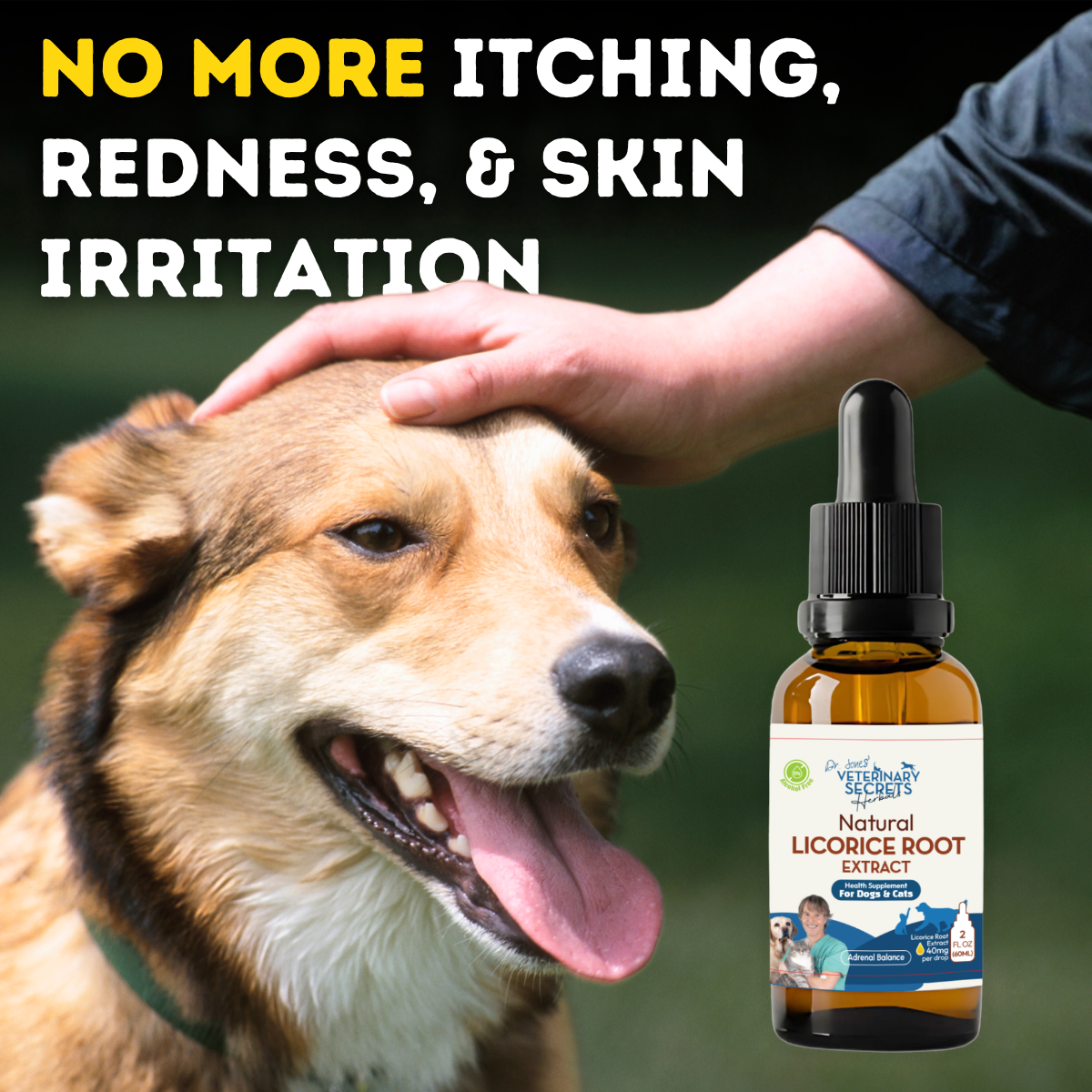
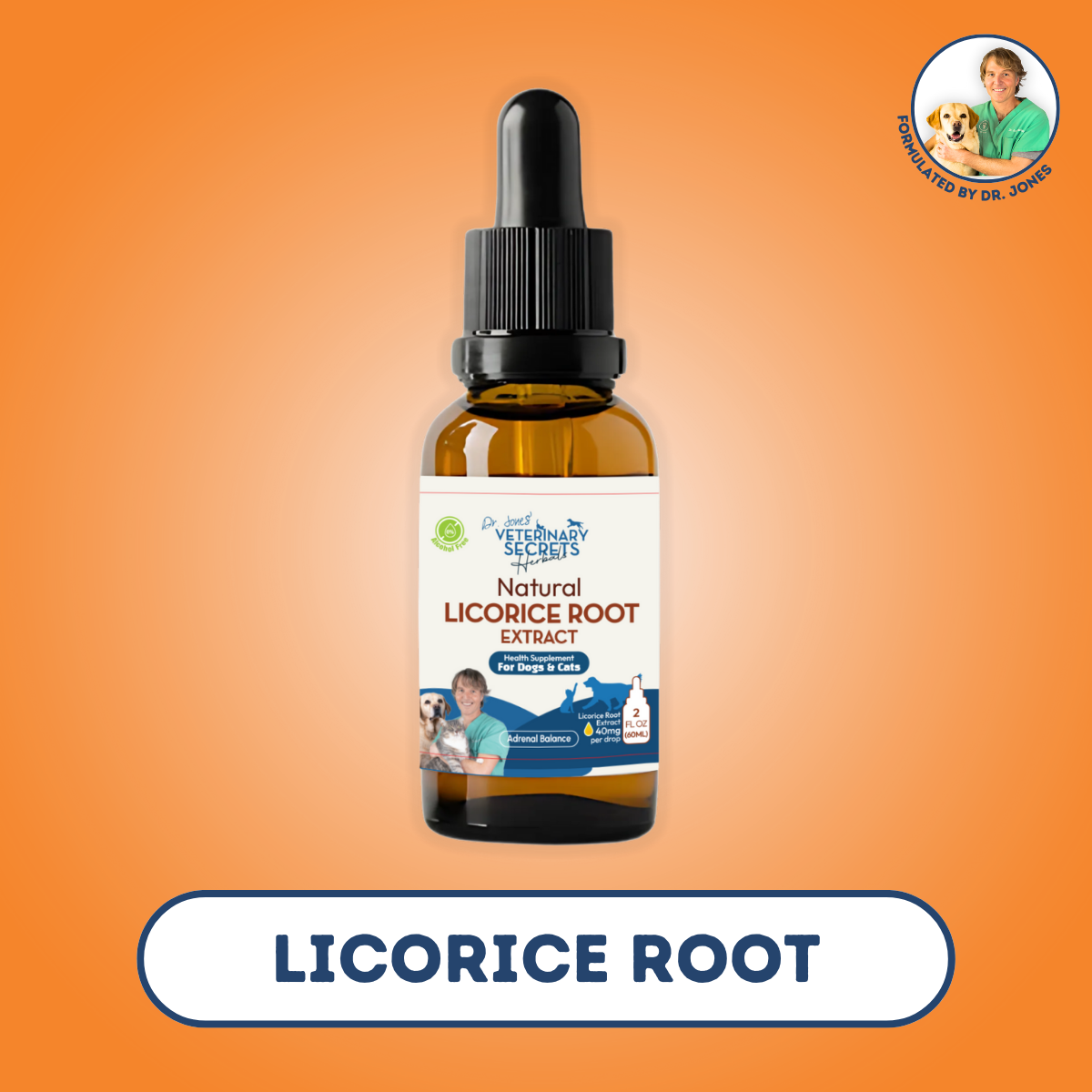
Dr. Jones’ Herbals: Licorice Root Extract

What Is Slippery Elm?
Slippery elm, also known as Ulmus fulva, is an herbal remedy made from the inner bark of the slippery elm tree.
The inner bark is soft and stringy.
That texture is part of what makes it useful, but it also makes it a bit challenging to prepare.
It does not grind easily with a mortar and pestle.
That is why I usually suggest buying it in capsule form. The capsule contains slippery elm already ground into a fine powder, which makes it much easier to mix with water, food, or make into a syrup.
Why Is Slippery Elm Safe for Pets?
Slippery elm is considered very safe and nontoxic for pets.
That is one reason I like it.
Some herbs need a lot of caution in dogs and cats.
Slippery elm is a happy exception.
It is gentle, soothing, and usually well tolerated by both dogs and cats.
It also has a mild, slightly sweet taste.
That matters.
Because if your cat thinks the remedy tastes suspicious, congratulations, you now own an expensive bowl decoration.
What Nutrients Are in Slippery Elm?
Slippery elm contains several nutrients, including:
-
Carbohydrates
-
Protein
-
Fat
-
Ascorbic acid
-
Beta-carotene
-
Calcium
-
Trace minerals
These nutrients make slippery elm especially useful for recuperating pets.
It may even stay down when other foods are not tolerated.
Historically, slippery elm has been known as an “emergency” food. George Washington and his troops reportedly survived for days during the bitterly cold winter at Valley Forge on gruel made from slippery elm bark.
Not exactly gourmet.
But useful.
And sometimes useful beats gourmet.
How Does Slippery Elm Work?
The main benefit comes from slippery elm’s mucilage content.
Mucilage is the soothing, slippery, gel-like material that forms when slippery elm is mixed with water.
In the digestive tract, it can coat, soothe, and lubricate the mucous membranes.
Think of it as a natural coating remedy for irritated tissue.
A little like a natural Pepto-Bismol effect.
But do not use Pepto-Bismol in pets.
Pepto-Bismol should not ever be used in pets because it contains salicylate, also known as aspirin.
Slippery elm is the gentler option here.
Slippery Elm for Vomiting, Diarrhea, and IBD
For digestive problems, slippery elm works directly in the gastrointestinal tract.
It coats, soothes, and lubricates the digestive lining.
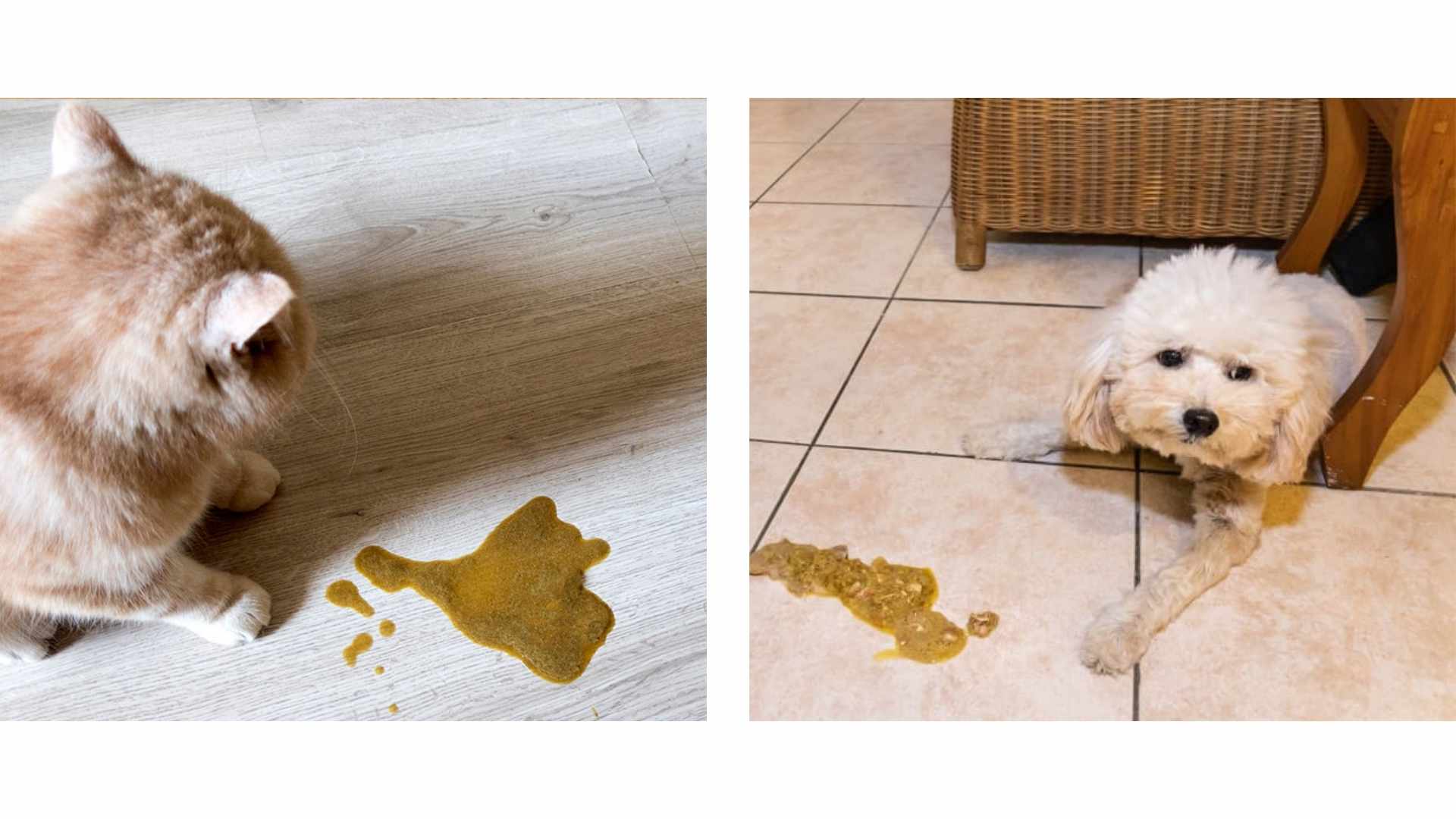
That makes it useful for:
-
Vomiting
-
Diarrhea
-
Constipation
-
Gastritis
-
Colitis
-
Inflammatory bowel disease
One of the useful things about slippery elm is that it is high in fiber.
That means it can help normalize intestinal action.
So yes, it can be used for both diarrhea and constipation.
That sounds odd at first.
But the goal is not to “stop” or “push” the bowel blindly.
The goal is to help normalize what the gut is doing.
The gut appreciates that kind of calm leadership.
Slippery Elm for Kidney Disease Nausea
Slippery elm may also help pets with nausea and vomiting from non-digestive illnesses, including kidney disease.
Cats with chronic kidney disease, or CKD, can feel nauseous.
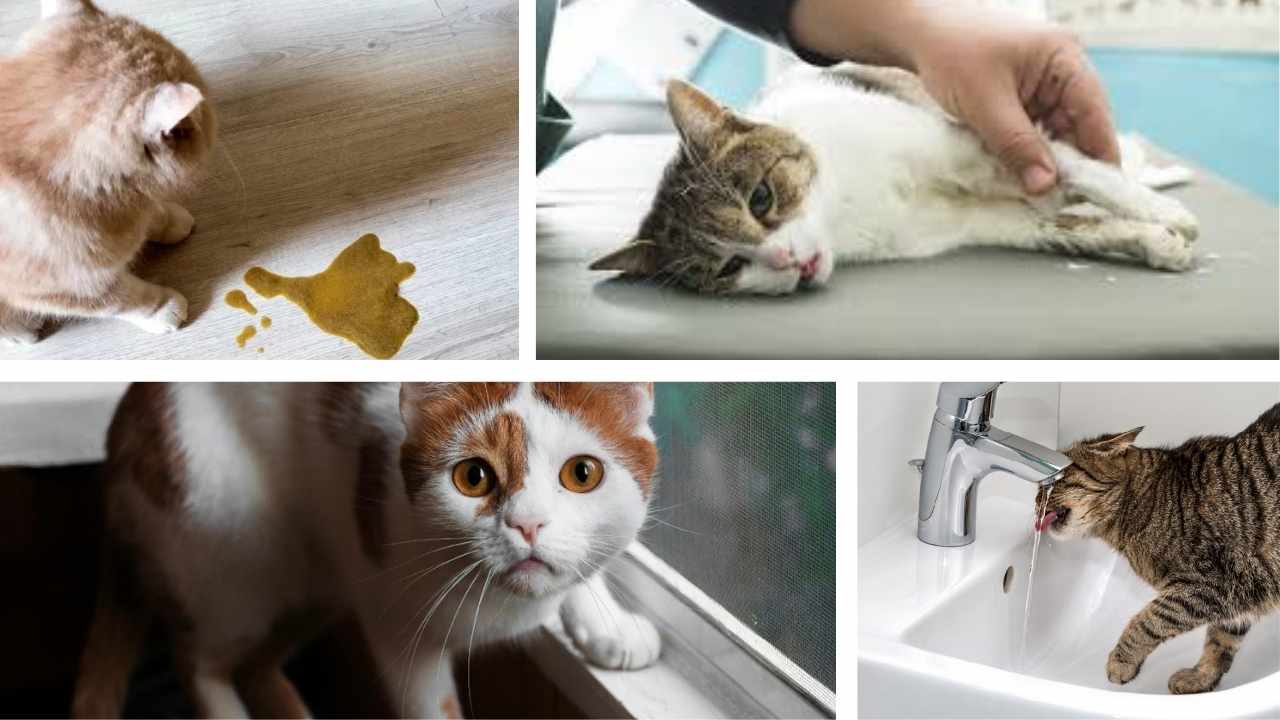
They may not want to eat.
They may vomit.
A slippery elm syrup can be helpful in some of these cases because it coats and soothes.
It is not curing kidney disease.
But it may help the pet feel more comfortable.
And with CKD cats, comfort and appetite matter.
A lot.
Slippery Elm for Mouth Ulcers
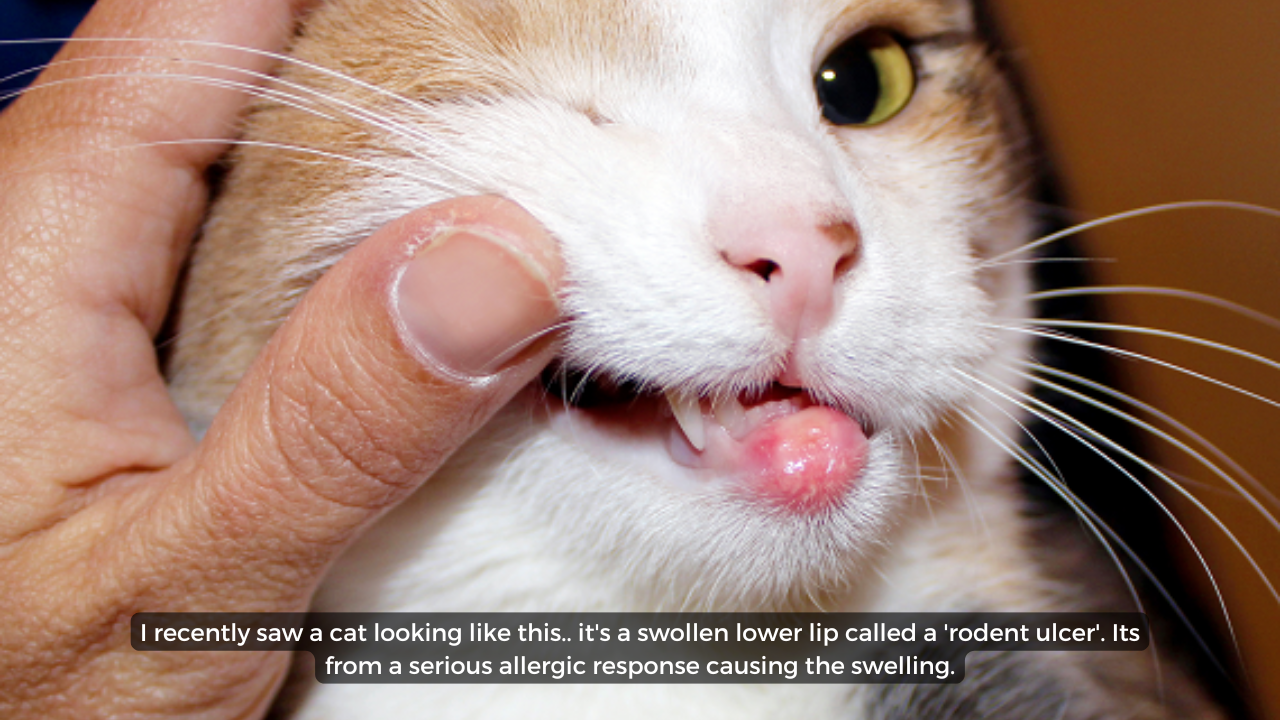
Slippery elm syrup can help soothe mouth ulcers from many causes.
The goal is to coat the ulcerated tissue directly.
For mouth ulcers, give the slippery elm by syringe so it touches and coats the sore areas.
Timing matters here.
Try to give it at least an hour before or after food.
That gives it more time to sit on the irritated tissue.
Slippery Elm for Coughs and Sore Throat
Slippery elm can also be used for coughs and sore throat.
For this, give it by syringe and try to coat the back of the throat as much as possible.
Be gentle.
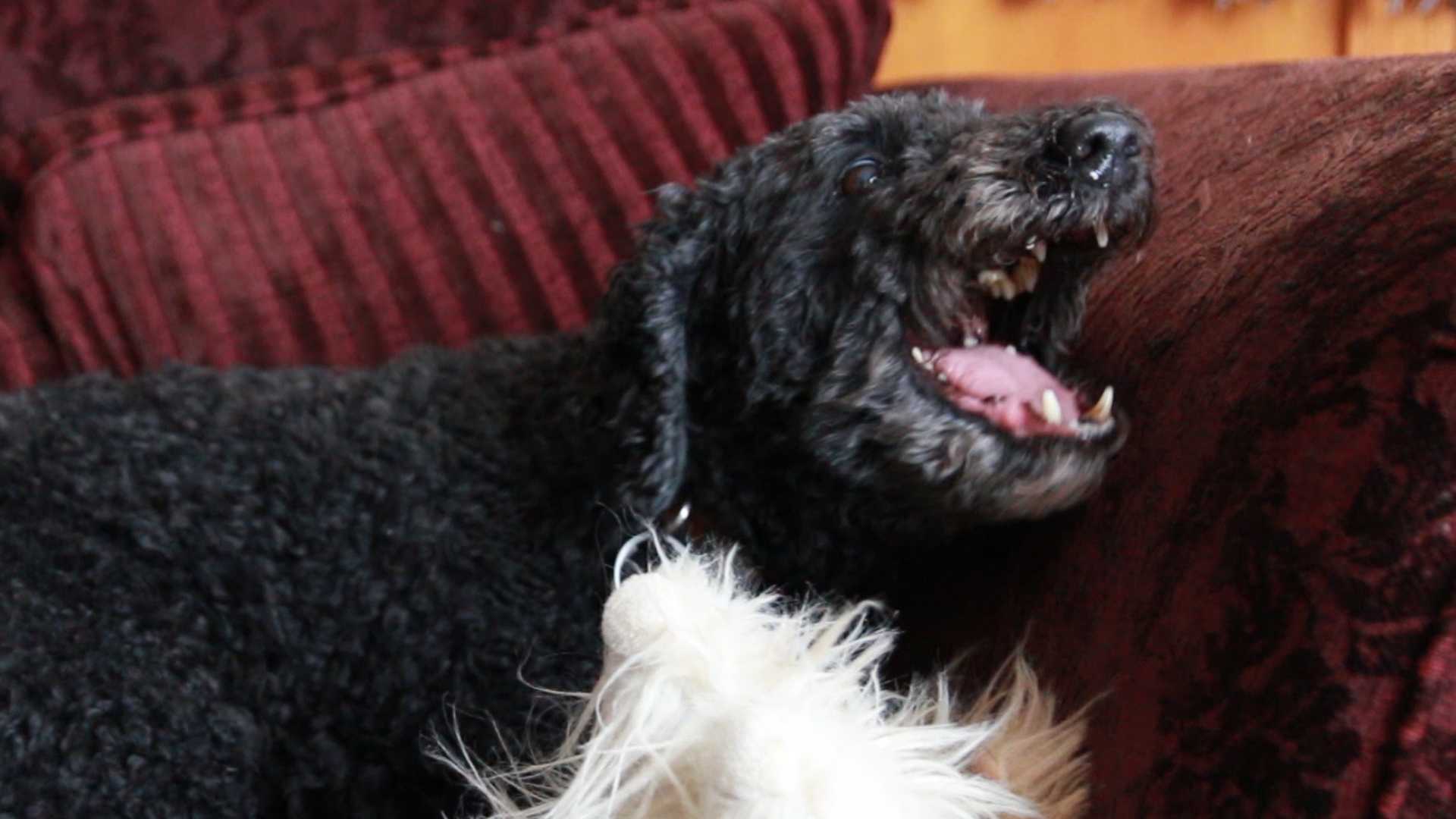
Stop immediately if your pet chokes or struggles.
The idea is to soothe the throat.
Not start a wrestling match in the kitchen.
Slippery Elm for Bladder Inflammation
Slippery elm is said to relieve inflammation of mucous membranes.
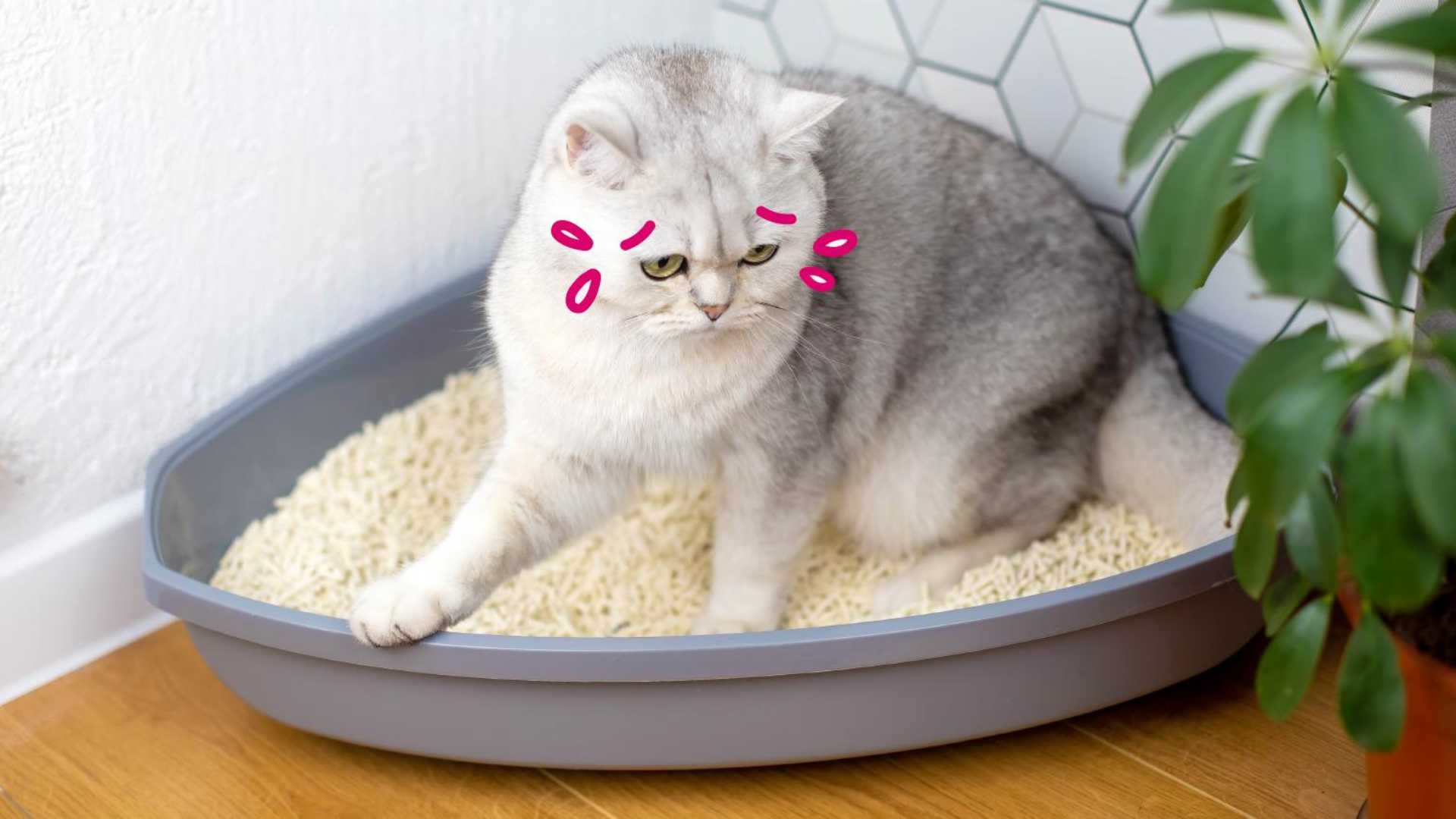
It has been used for inflammatory conditions involving the:
-
Lungs
-
Bronchitis
-
Asthma
-
Kidneys
-
Bladder
-
Cystitis
-
FLUTD symptoms
-
Throat
-
Tonsillitis
-
Joints
-
Arthritis
For bladder inflammation, slippery elm is thought to soothe the bladder lining.
There is no direct connection between the digestive tract and urinary tract, but slippery elm’s antioxidant and anti-inflammatory components may be part of the benefit.
Caution: Slippery Elm and Urinary pH
Slippery elm contains magnesium.
Because of that, it may not be a good choice if your pet has:
-
Elevated urinary pH
-
A bacterial infection
-
Risk of struvite crystals
Struvite crystals are magnesium ammonium phosphate crystals.
If your pet is dealing with elevated urinary pH or a bacterial urinary infection, magnesium may be a concern.
So in those cases, be cautious.
This is especially important for cats with urinary tract disease.
Why Slippery Elm May Help Cats With Bladder Issues
Slippery elm bark contains natural pentosans.
Pentosans are complex sugars.
They contain the same compound found in the pharmaceutical drug Elmiron, which is used as a major pain-relieving treatment for interstitial cystitis in women.
Pentosans have been used by the pharmaceutical industry as anticoagulants and anti-inflammatories for more than 40 years.
At normal doses, anticoagulant effects are not seen.
Because bladder disease in cats is very similar to bladder disease in women, slippery elm may be especially useful for feline friends.
Small, frequent doses of pentosan have been shown in people to be more effective than one large dose.
The same may be true for cats.
Tiny frequent support.
Very cat-like, really.
Slippery Elm for Skin Problems
Slippery elm powder can also be used externally.
You can make a soothing paste by mixing slippery elm powder with cold water.
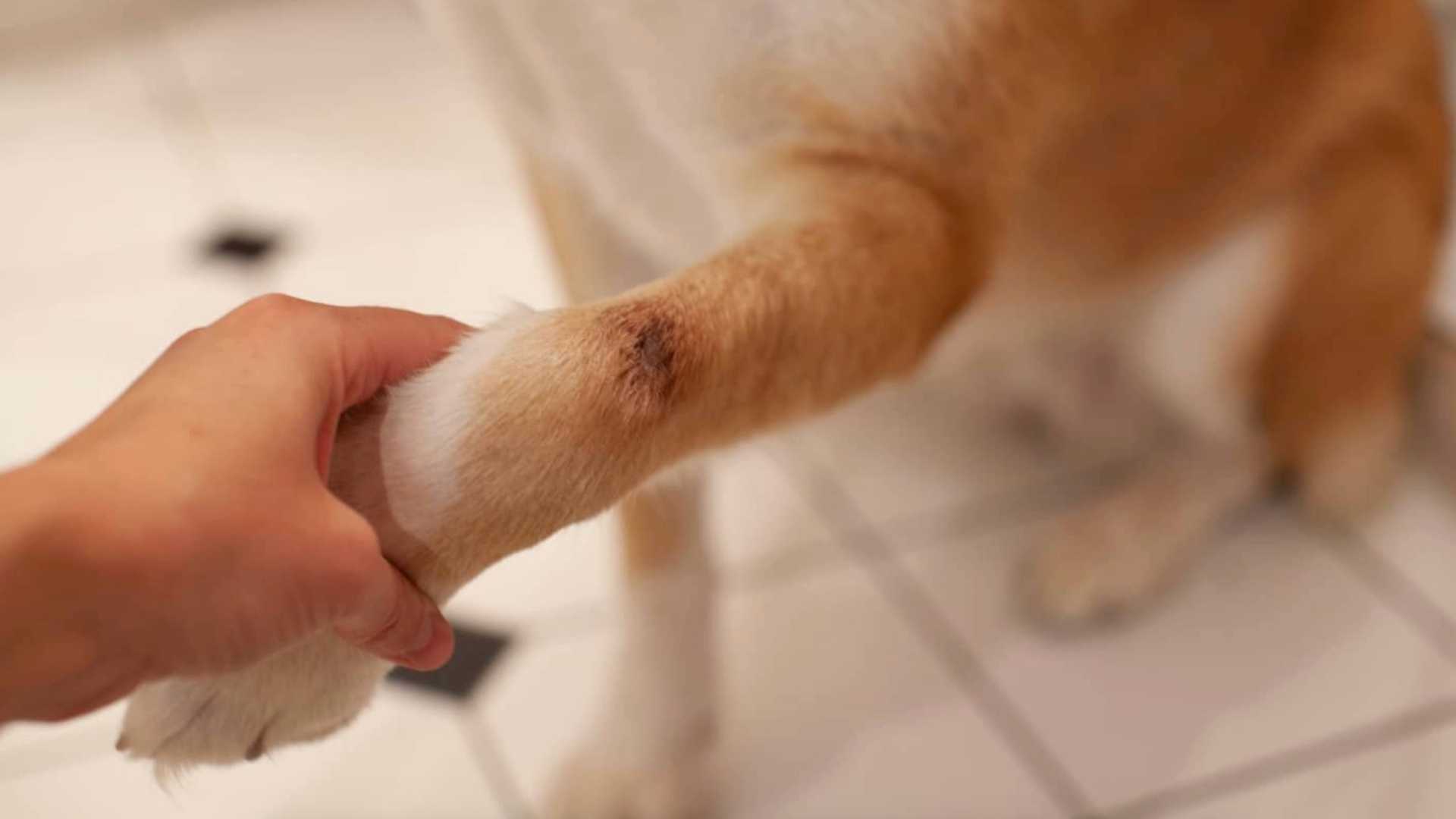
This paste can be used as a poultice for:
-
Hot spots
-
Insect burns
-
Rashes
-
Scratches
-
Ulcerated areas
-
Shallow wounds
Apply it to the affected area and allow it to dry.
Native Americans used slippery elm bark to stop bleeding.
It forms a natural “bandage” that can be left in place for several hours.
That is, of course, assuming your dog does not lick it off in 4.3 seconds.
To remove it, just moisten it with water.
Slippery Elm and Cancer
Slippery elm is one of the herbs used in the original formulation of Essiac, also called Ojibwa Tea, an herbal mixture widely promoted as a cancer-fighter.
That does not mean slippery elm is a cancer cure.
But it does show that slippery elm has a long history of use in traditional herbal formulas.
How Do You Give Slippery Elm to Dogs and Cats?
Slippery elm powder absorbs many times its own weight in water.
So always add enough warm water to make a gruel.
You can give this gruel:
-
By syringe
-
By eyedropper
-
Mixed into baby food
-
Mixed into canned food
-
Mixed into a homemade diet
It has a mild, slightly sweet taste and is usually well tolerated.
Basic Slippery Elm Capsule Dose
Use:
1 capsule per 10 to 20 lbs of body weight daily
This refers to a 400 mg capsule.
Open the capsule and mix the contents with warm water.
Make sure you add enough water to create a soft gruel.
Slippery Elm Syrup Recipe
Author Anitra Frazier gives a simple slippery elm bark syrup recipe in The New Natural Cat. This recipe also applies to dogs when adjusted for weight.
Ingredients
| Ingredient | Amount |
|---|---|
| Cold water | 1/2 cup |
| Powdered slippery elm bark | 3/4 teaspoon |
How to Make It
-
Add 1/2 cup cold water to a small saucepan.
-
Add 3/4 teaspoon powdered slippery elm bark.
-
Whip with a fork to break up clumps.
-
Bring to a simmer on low heat.
-
Stir constantly.
-
Simmer for 1 to 2 minutes.
-
Stop when it thickens to a syrup or molasses consistency.
-
Cool.
-
Refrigerate for up to 7 days.
Commercial slippery elm syrups are also available.
Slippery Elm Dosage Table
| Use | Dose |
|---|---|
| Daily capsule use | 1 capsule per 10 to 20 lbs daily, using a 400 mg capsule |
| GI problems | 1/2 capsule or 1/2 to 1 teaspoon syrup per 15 lbs |
| GI timing | 30 to 60 minutes before meals, with meals, or just after meals |
| Mouth ulcers | Give by syringe to coat ulcerated tissue |
| Sore throat or cough | Give by syringe to coat the back of the throat |
| Cystitis, asthma, or inflammatory problems | Give 3 to 4 times daily |
| Cat dose limit guidance | 5 ml is more than enough for a cat |
| Large dog dose guidance | 20 to 30 ml may be reasonable |
When Should You Give Slippery Elm?
Timing depends on what you are using it for.
For Long-Term Use
For long-term use, it may be best to give slippery elm away from meals, supplements, and medications by at least an hour.
A bedtime dose can also be useful.
Giving it separately allows it to work undisturbed and may enhance its benefits.
Since cats and small dogs are often fed 3 to 4 times daily, slippery elm can often fit into that schedule.
Timing With Medications
This is important.
Give medications 1 to 2 hours before slippery elm.
Why?
Because slippery elm creates a mucilaginous coating.
That coating may inhibit medication absorption.
Because slippery elm is nutritious, there is less concern about giving it near meals.
But with medications, separate the timing.
Medication first.
Slippery elm later.
The stomach does not need a scheduling conflict.
How to Use Slippery Elm for Gastrointestinal Problems
For gastrointestinal problems, give slippery elm:
30 to 60 minutes before meals, with meals, or just after meals
If the problem is in the upper GI tract, such as the stomach or small intestine, giving it before meals may provide the best protection.
If the problem is in the large intestine, such as constipation or inflammatory bowel disease, giving it with food or just after meals may be better.
GI Dose
Give:
1/2 capsule or 1/2 to 1 teaspoon of syrup per 15 lbs of body weight
That equals:
2.5 to 5 ml per 15 lbs
How to Use Slippery Elm for Mouth and Throat Problems
For mouth ulcers, give slippery elm by syringe and coat the ulcerated tissue.
Give it at least an hour before or after food.
For sore throat or cough, give by syringe and try to coat the back of the throat.
Stop immediately if choking occurs.
Use plenty, but do not overdo it.
This is an endangered plant.
For a cat, 5 ml is more than enough.
For a large dog, 20 to 30 ml may be reasonable.
How to Use Slippery Elm for Cystitis, Asthma, or Inflammatory Problems
For cystitis, asthma, or other inflammatory problems, give slippery elm:
3 to 4 times daily
Small, frequent dosing may be especially useful for cats with bladder inflammation.
How to Use Slippery Elm for Skin Problems
To make a skin poultice:
-
Mix slippery elm powder with cold water.
-
Stir until it forms a paste.
-
Apply to the affected area.
-
Let it dry.
-
Leave it in place for several hours if possible.
-
Moisten with water to remove.
This can be used for shallow skin problems such as:
-
Hot spots
-
Rashes
-
Scratches
-
Insect burns
-
Ulcerated areas
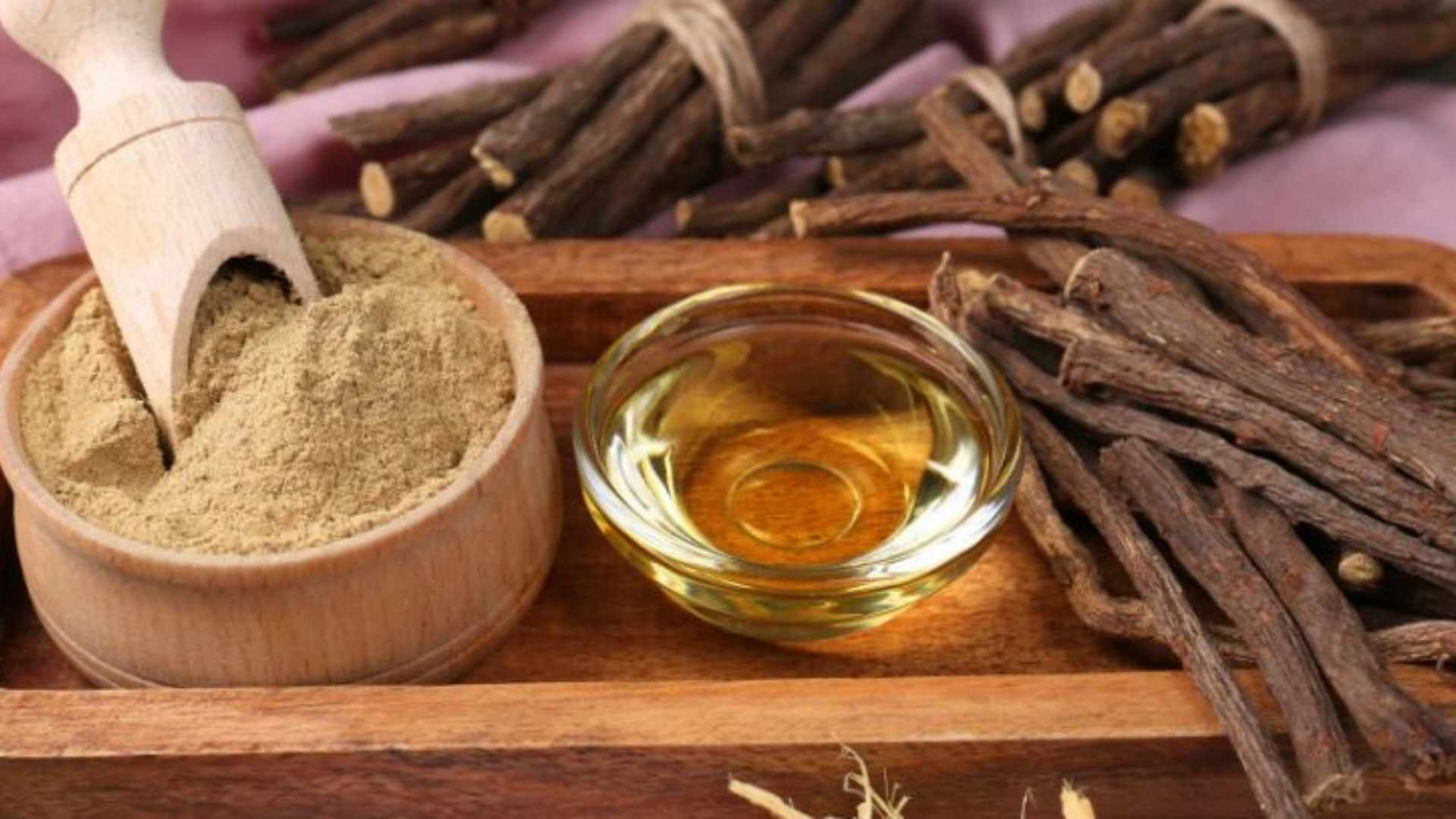
What About Licorice Root for Pets?
Licorice root is another herb I really like.
It can help with many different pet health conditions and is reasonably priced.
Studied benefits of licorice root include support for:
-
Allergies
-
Cough
-
Sore throat
-
Natural antiviral support
-
Flu support
-
Stomach ulcers
-
Digestive support
-
Inflammation
-
Immune system support
-
Autoimmune disease
It worked especially well for one of my allergic dogs.
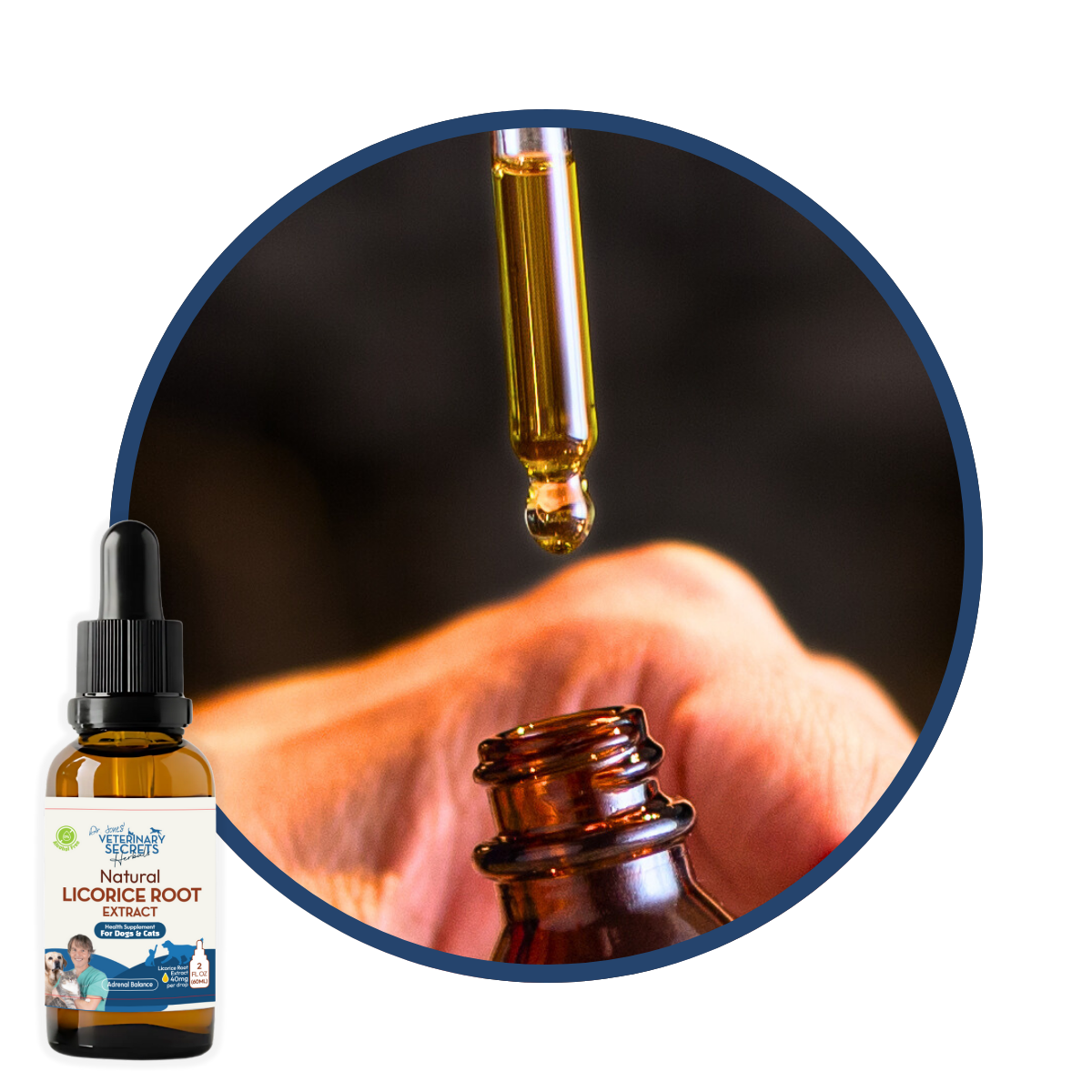
Dr. Jones’ Licorice Root Extract for Pets
Licorice root is one of my favorite herbs because it is so versatile.
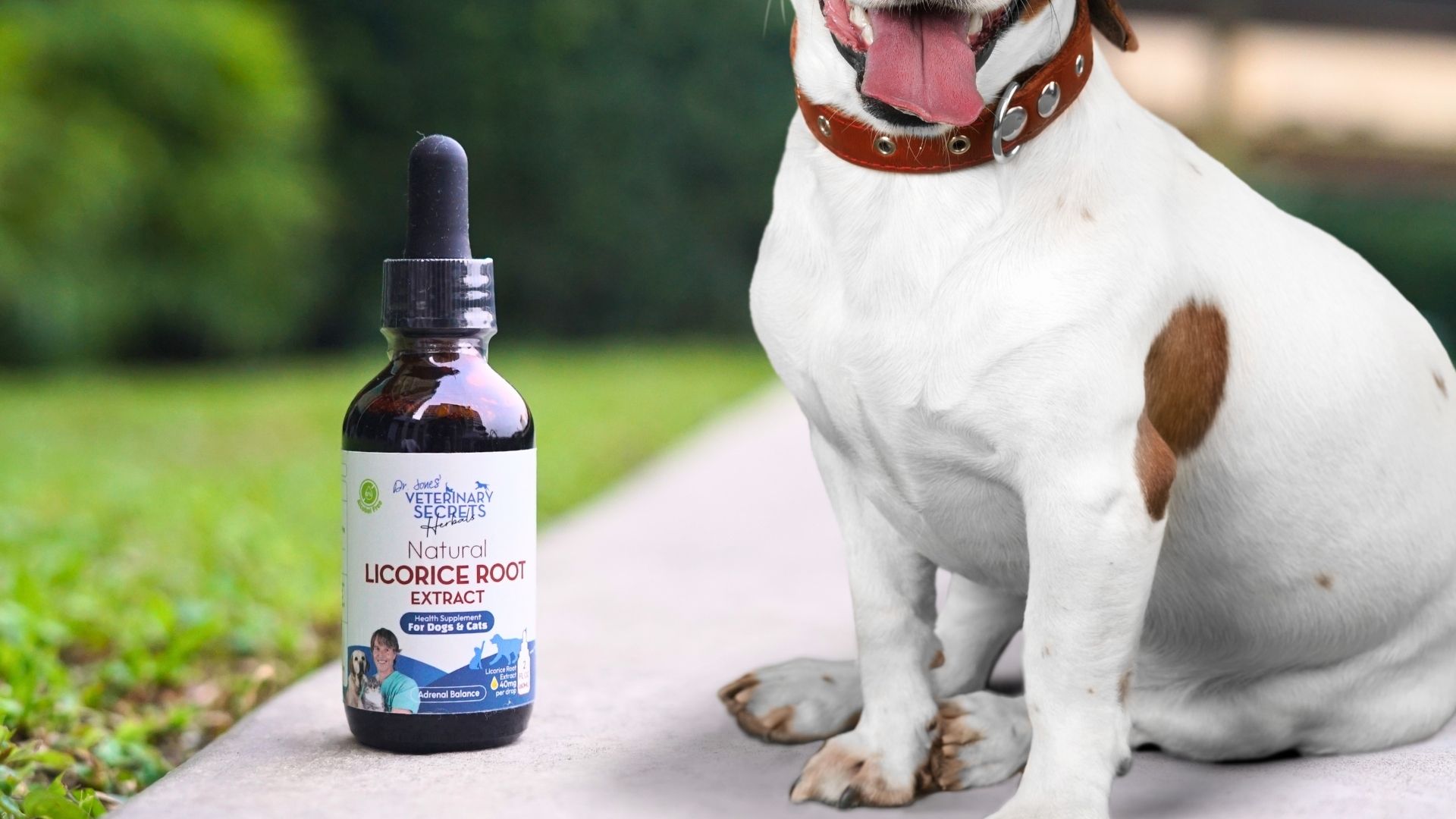
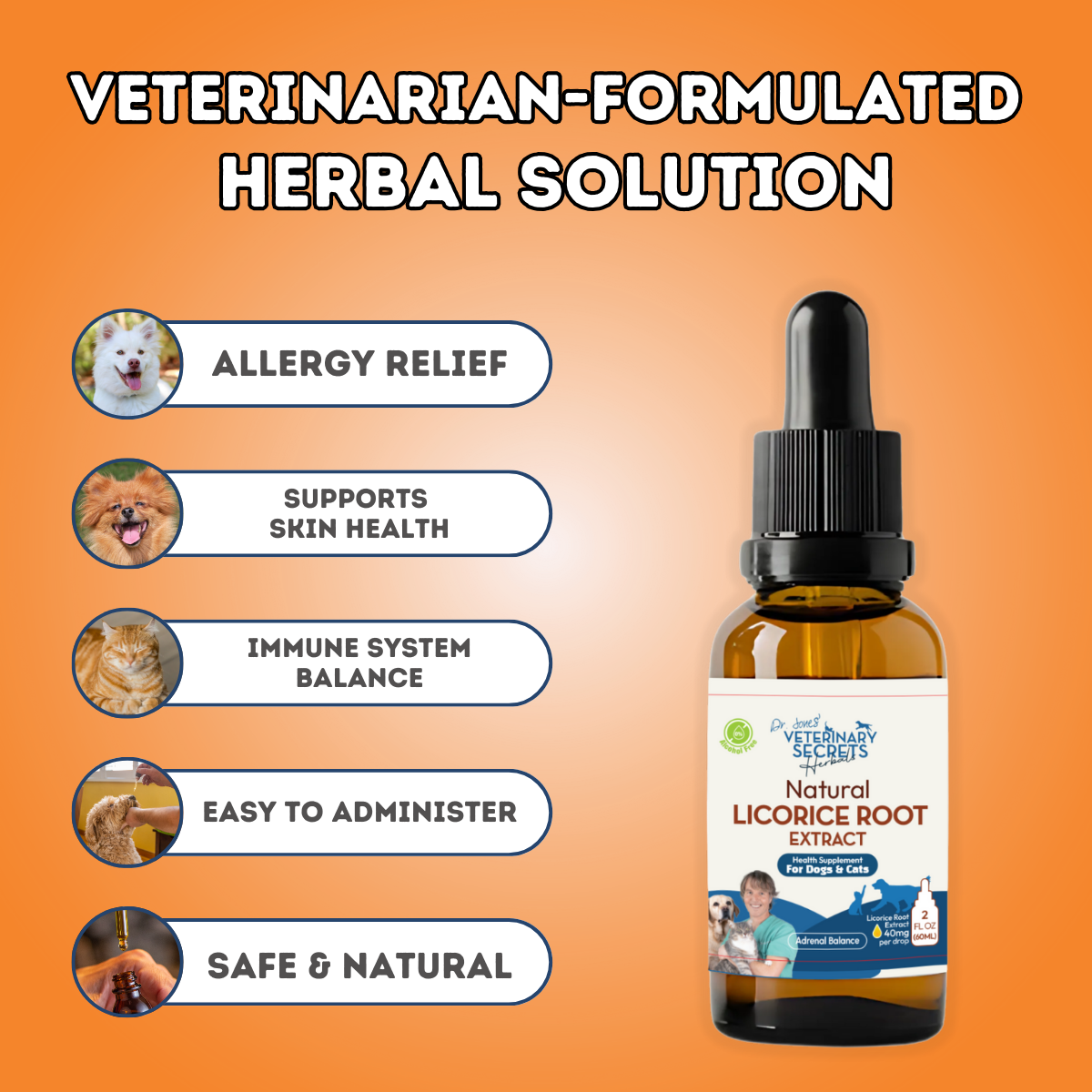
It may help with allergies, coughing, digestive support, stomach ulcers, inflammation, antiviral support, and immune system support.
Licorice Root Benefits for Pets
1. Allergies
Licorice root contains glycyrrhizin.
Glycyrrhizin is a glycoside that acts like a natural corticosteroid, but without the adverse effect of weakening the immune system.
2. Cough and Sore Throat
Licorice root is well known for helping ease congestion from coughs and colds.
It acts as an expectorant, helping loosen and expel phlegm.
It also has a soothing effect on irritated mucous membranes.
3. Stomach Ulcers and Digestive Support
Licorice root has antibacterial properties and may help relieve stomach ulcers.
It may also support digestion.
4. Anti-Inflammatory and Immune Support
Licorice root has broad-spectrum antiviral activity.
It may also support inflammation and immune system balance.
5. Topical Anti-Itch Remedy
Licorice root can also be used in a topical anti-itch remedy.
Anti-Itch Recipe
| Ingredient | Amount |
|---|---|
| Coconut oil | 1 tablespoon |
| Lavender oil | 5 drops |
| Licorice root tincture | 1 ml |
How to Use It
Apply topically to the affected area:
Twice daily for 7 to 14 days
Slippery Elm vs Licorice Root: Which One Should You Use?
These herbs are different, and I would think of them differently.
| Herb | Best Used For | Why I Like It |
|---|---|---|
| Slippery elm | GI upset, vomiting, diarrhea, constipation, IBD, cough, mouth ulcers, bladder inflammation, minor skin wounds | Coats, soothes, lubricates, and is very safe |
| Licorice root | Allergies, cough, sore throat, stomach ulcers, digestive support, inflammation, immune support | Natural corticosteroid-like action, expectorant support, antiviral activity |
If your pet has digestive irritation, nausea, mouth ulcers, or a sore throat, I would think about slippery elm first.
If your pet has allergies, cough, congestion, or inflammation, licorice root may be the herb I reach for.
Different jobs.
Both useful.
Nice when herbs know their role.
Final Thoughts
Slippery elm is one of my favorite herbal remedies for dogs and cats.
It is safe, gentle, and surprisingly useful.
It can help coat and soothe irritated tissue, especially in the digestive tract.
I would consider it for vomiting, diarrhea, constipation, inflammatory bowel disease, gastritis, colitis, mouth ulcers, coughs, sore throat, kidney-related nausea, bladder inflammation, FLUTD-type symptoms, and minor skin wounds.
The key is using it properly.
Mix it with enough water.
Separate it from medications by 1 to 2 hours.
Use small, frequent dosing when needed.
And be cautious with urinary issues involving elevated pH, bacterial infection, or struvite crystal concerns.
Licorice root is another excellent herb to know about, especially for allergies, cough, sore throat, stomach ulcers, inflammation, immune support, and topical itching.
Natural remedies are not about throwing herbs randomly at symptoms.
They are about matching the remedy to the tissue that needs support.
Slippery elm soothes.
Licorice root supports inflammation and allergy-type issues.
Simple.
Practical.
And very useful when your pet needs gentle help.
Click To Get A Free Copy of My E-Book!

P.S. Should you be using slippery elm?
Yes, in many cases.
It is very safe, very effective, and I have seen it work so well for coughs and gastrointestinal disorders.
P.P.S. If your pet is on medication, give the medication 1 to 2 hours before slippery elm.
That soothing coating is helpful, but it can interfere with medication absorption if the timing is too close.
P.P.P.S. Licorice root is another one of my favorite herbs.
For itchy skin, you can mix 1 tablespoon coconut oil, 5 drops lavender oil, and 1 ml licorice root tincture, then apply it topically twice daily for 7 to 14 days.
Quick Guide: What Slippery Elm May Help
| Problem | How Slippery Elm May Help |
|---|---|
| Vomiting | Coats and soothes the stomach lining |
| Diarrhea | Helps normalize intestinal action |
| Constipation | High fiber content may help bowel movement |
| IBD | Soothes inflamed digestive tract tissue |
| Gastritis | Coats irritated stomach lining |
| Colitis | Supports large intestine irritation |
| Mouth ulcers | Syrup may coat and soothe ulcerated tissue |
| Kidney disease nausea | May help nausea and vomiting from non-GI illness |
| Cough or sore throat | Can coat the back of the throat |
| Bladder inflammation | May help soothe mucous membranes and inflammation |
| Hot spots or minor wounds | Can form a soothing paste or natural bandage |