Cuddly Cat Or Killing Machine?
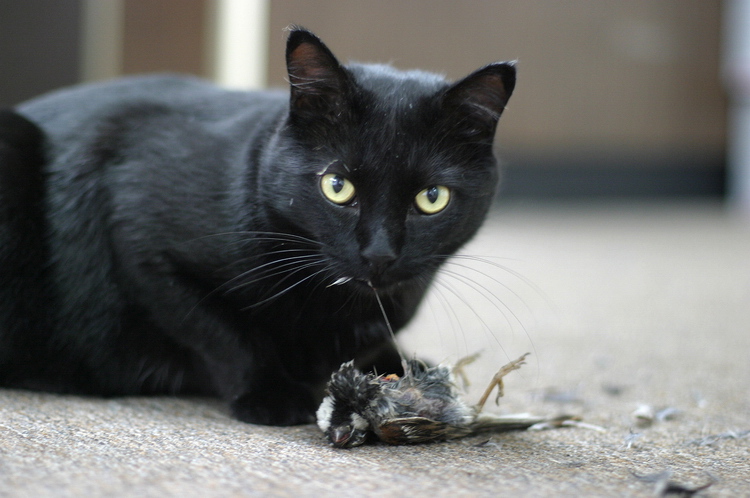
There has been a whole lot of talk lately about our cuddly cats; apparently they are also killing machines. Smithsonian Conservation Biology Institute and the Fish and Wildlife Service have said that cats in the U.S. kill in the range of 1.4 and 3.7 million birds, plus an astonishing 6.9 and 20.7 billion native mammals, such as shrews and chipmunks. Cats are directly linked to species extinction of certain birds, mammals and specific reptiles.
Our wild animal populations are in decline, such as one out of every 3 bird species, and cats are clearly part of the problem. Cat population estimates in the U.S. show 85 million house cats, and another 80 million feral and stray cats. The study claims that the stray cats commit the bulk of the carnage, killing 70% of the birds, and 90% of the mammals.
These numbers, and percent of wildlife affected is all far higher than ever thought; rates are two to four times higher. The report notes that more small mammals and birds are killed by cats than are killed by toxins, vehicles, and building collisions. Cats are a major problem for these wild animals.
So what can you do?
Clearly this report has an environmental slant, pointing to cats as these ‘horrible’ killing species, responsible for massive wildlife population decline. The bulk of the killing is not coming from domestically owned cats, but from the stray population. We need to ensure that as many cats as possible are spayed and neutered, and that we are not further increasing the population. I applaud the veterinarians and rescue groups who trap the stray cats, having them altered, so they are not further contributing to the problem.
We need to get more of these stray and feral cats in households, and off the streets. Cats in households have pet owners, who can then regulate their pet. Domestically owned cats do a fraction of the damage; these stray cats would be much happier being part of someone’s home. A well fed and loved cat doesn’t feel the need to be always hunting.
Our domestic cats though are not ‘off’ the hook; our house cats are still responsible for killing millions of birds, and small mammals.
In my opinion, our domestic cats should be strictly indoors, and only be outside supervised. The benefits of having your cat indoors are not only helping the bird population, but means your cat will live longer. Being inside means your cat avoids predators such as coyotes, car accidents, cat fight wounds, infectious diseases along with toxins such as antifreeze. You will no longer need to give your cat vaccines, you can avoid the vaccine side effects, and you will have fewer trips to your veterinarian.
Change is hard though, and with the millions of cat that are allowed to be outside, there are a few things you can be doing to help. Get your cat fitted with a bell on his collar, or a ‘leap activated collar. These collars produce an audio and visual alarm which is activated by the movement when a cat jumps to attack a bird. The alarm frequency scares off the birds, but doesn’t bother cats. Plan to have your cat inside when the birds are often feeding and most vulnerable to attack; at sunset, sunrise and after bad weather.
Certain wild animal populations are in serious decline, and clearly cats are a substantial part of the problem. As responsible pet owners, it is incumbent on us to actively be part of the solution. We must actively support spay and neuter programs of stray cats, and then get more of these cats placed in shelters and adopted. We must look at having as many of our house cats as possible remain as indoor cats, only being outside while supervised. If cats are outside they need to be fitted with collars that warn the birds, decreasing cat predation. I suggest you follow my example to become part of the solution. My previous outdoor cats are now strictly indoor cats who will live longer, avoid unnecessary injury and disease and not kill a single bird or small mammal.
Best Wishes,
Dr Andrew Jones, DVM
My cats live both outdoors and indoors, and I believe are much happier and live a much more natural life. Yes they get illnesses that indoor cats don’t get, but I don’t believe over protecting them is good for them. Yes they catch mice and rats – thank goodness or else I would be overrun with them. I like to see nature be nature and not tampered with. I would never use rat poison or traps, so at least they have a fighting chance. Unfortunately in the past year I have lost two cats, both of whom were good ratters, the remaining two don’t seem as interested. Now I have rats or mice living under the bonnet of my car using it as a dining room…..never had that problem before. Let cats live a natural free life I say.
Thanks for sharing your experience!
Cats are amazing little hunters—that instinct is part of what makes them cats! The challenge is finding a balance between allowing them enrichment and keeping them safe, while also being mindful of local wildlife.
A supervised outdoor time, a secure catio, or safe outdoor alternatives can give cats that “adventure” while reducing risks from cars, predators, disease, and wildlife impact.
Happy, healthy cats and a thriving environment can go hand in hand!
I am in receipt of Dr.Jones’newsletter and want to state how very much I appreciate him and his knowledge. His article here regarding “Cats” is most needed and appreciated.
I learned from a TV Documentary a couple of years
ago that the cat population is greater than the human population!
Please do keep your cats indoors and spay/and/or neuter as in keeping with your lifestyle.
Thank you.
Thank you for your kind words and support.
Cats are wonderful companions, and being a responsible pet guardian means considering both their health and their impact on the world around them. Spaying/neutering and providing a safe environment are important steps in helping cats live long, happy lives.
Thanks for caring about our feline friends!
Such total ignorance of how nature works is totally mind boggling. Cats have been “killing machines” for centuries. Somehow the bird and rodent population has survived and even thrived throughout history.
This study was funded by a cat hating European who pays shelters in his country approx $5.00 for every cat they exterminate. If you thought corruption was only in government you would be wrong. When a person with money can fund studies and manipulate the results you know our civilization is in serious trouble. Not only that, they also made sure this “study” had a big media push. Sickening.
Cats don’t need to be kept prisoner except for their own safety in ares with busy streets. Many areas have serious rodent populations because they have no “killing machines” to control the population. Do we think leaving poison out is a better idea than the exterminator already provided by nature?
Thank you for sharing your perspective.
Cats are natural hunters, and that instinct is a big part of who they are. The goal is finding a healthy balance, keeping cats safe while also being mindful of local wildlife.
For many cats, supervised outdoor time, enrichment, and responsible pet ownership can help support both their well-being and the environment.
Thanks for caring about our feline companions and the world they share with us.
Dogs chase cats; Cats chase mice/birds; Birds eat worms; etc. Much wildlife is disappearing, almost totally at the hands of humans. A bison or wolf killed at the paws of a cuddly (house/domestic) cat??
Thanks for sharing your thoughts.
Nature is full of predators and prey—it’s a complex balance that has existed for thousands of years. The bigger concern today is the overall impact humans have had on wildlife through habitat loss, pollution, and other environmental changes.
Cats are natural hunters, but responsible pet ownership (like spaying/neutering and supervised outdoor time) can help us protect both our feline friends and local wildlife.
I am a firm believer in indoor-only cats. Also, I whole-heartedly support trap, neuter release programs for feral cats. My big concern with the above cited report, and others like it, is the way numbers were gathered and how the numbers were used. Statistical data can be misused and/or purposely skewed and the subsequent “report” be made to indicate whatever the authors want to say. I have yet to read an OBJECTIVE, ie. UNBIASED, review of the statistical methods used to substantiate this report. I will readily admit that feral cats do kill to eat. Obviously, they kill what is easiest to catch and what they are hereditarily programed to eat. IRRESPONSIBLE HUMANS ARE TO BLAME FOR THE ALARMING NUMBERS OF HOMELESS CATS. LET US ATTACK THE PROBLEM AT THE ROOT CAUSE: HUMANS.
Thank you for sharing your thoughtful perspective.
You make an important point—responsible pet ownership is a big part of the solution. Spaying and neutering, helping feral cat populations, and providing safe environments for cats can make a real difference.
Cats are natural hunters, but humans also play a major role in creating many of the challenges we see today. Finding a balance that protects both cats and wildlife is the goal.
Thanks for caring about animals and being part of the conversation.
I disagree; that would be like keeping your dog in the house so it doesn’t get attacked by a wild animal if you happen to live in the country, or from being hit by a car in the city. I agree that cats should not be strictly outdoor cats, I hate seeing them hit on the side of the road; but cats are carnivores and are designed to eat birds, mice, etc. Even if you feed a raw diet, cats still like to catch little critters to eat (or not). It’s healthy for a cat to be outside doing it’s thing. Barn cats are outside 24/7 to do a job – keep the mice down. I think this is fine too. But house cats should be indoor/outdoor, my dad’s cat has never touched paws outside and he finally bought him a box of greens to chew and his cat loves it. They need outdoor fresh air and sunshine, just like us!
Thanks for sharing your perspective.
Cats are natural hunters, and that instinct is certainly part of what makes them unique. The important thing is finding the right balance for each cat—providing enrichment, fresh air, and stimulation while also considering risks like traffic, predators, disease, and local wildlife.
A safe outdoor option like supervised time, a secure enclosure, or a catio can be a great middle ground for many cats. Happy cats and responsible choices can go together.
Please do your research and stop spreading misinformation that will have dire consequences for cats.I agree with you Ellie and Donna. The reasons our “wildlife” is in decline is due to human overpopulation-habitat defragmentation,animal agriculture, habitat loss and deforestation as well as the fact that the US fish and wildlife routinely poison, trap, snare over 4 million silvan animals per year. All with our tax dollars. http://www.sacbee.com/2012/04/28/4450678/the-killing-agency-wildlife-services.html.
The level of misinformation in this blog has been steadily increasing. This is a glaring example, I don’t know if I can believe any of the health related information any more.PLEASE CROSS POST THESE ARTICLES TO OTHER CAT LOVERS.
Here is an article explaining the inconsistencies:
http://www.voxfelina.com/2013/02/garbage-in-garbage-out/
Including the bias the authors have:
Before considering their scientific evidence, a little background is in order.
Loss is a post-doctoral fellow at the Smithsonian Conservation Biology Institute, where, as regular readers will likely recall, Marra is employed as a research scientist. Will is a biologist with the U.S. Fish and Wildlife Service.
Long-time readers will also recall that Marra (a vocal critic of TNR) served as Nico Dauphiné’s advisor at the Smithsonian until October 2011, when she resigned after being found guilty of attempted animal cruelty. And Will, also an outspoken critic of TNR, helped Dauphiné land her post-doc fellowship there with a letter of recommendation.* (Her position was funded by USFWS, just as Loss’ is today.)
This article breaks down the data.
http://www.voxfelina.com/2013/02/issues-of-consumption-production-and-surplus/
from the article:
Which brings me back to those native bird species—seemingly targeted by free-roaming cats. It turns out that 57 of the 58 species (see table below) have been given a “Least Concern” conservation status by the International Union for Conservation of Nature.
The one exception, the Northern Bobwhite is considered “Near Threatened” because it has, according to BirdLife International, “undergone a large and statistically significant decrease over the last 40 years in North America.” The reason? “Widespread habitat fragmentation” and extensive hunting.
Thank you for sharing your concerns and the additional information.
This is an important conversation, and you’re right that conservation issues are complex. Wildlife declines are influenced by many factors, including habitat loss, pollution, human development, and other environmental pressures.
Cats are natural hunters, but responsible cat ownership—such as spaying/neutering, supporting humane feral cat programs, and making choices that fit both the cat’s needs and the local environment—can help create a better balance.
I appreciate your passion for cats and wildlife, and the reminder that we should always keep learning and look at the full picture
My cats are indoor only–they don’t want to go outside. I believe they know how good they have it! They enjoy birdwatching from the window. I have stopped vaccinating to my vet’s chagrin.
Killing machines? It’s their nature!
Thanks for sharing your experience.
Cats are fascinating creatures, and their hunting instincts are a natural part of who they are. Many indoor cats live very happy, enriched lives with play, stimulation, and a good view of the “bird channel” from the window!
Keeping cats safe while respecting their natural behaviors is all about finding the right balance. Thanks for caring for your feline companions!
Yes, cats are killing machines as Tanya states. That’s why I won’t have one – dogs only rule here!
Thanks for sharing your thoughts.
Cats are natural predators, and hunting is part of their instinct—but they’re also loving companions who bring a lot of joy to many homes. Dogs and cats may be different, but both have their own unique ways of being amazing animals.
Thanks for celebrating the animals you love!
When the cat kill in NZ* was analysed very few of the birds caught were threatened species. Also more of the kill was noxious animals like mice, rats, rabbits and stoats etc. Belling your cat to warn birds would also warn rats and mice! Even when I had two hunting cats I still had a garden full of birds.
I don’t have a cat at the moment and once my last cat died the mice and rats moved in. I hate having to trap or poison them and then dispose of the corpses.
In the middle ages there was a campaign, in Europe, to eradicate cats (and incidentally dogs) thus removing the first line of defence against rats which carried the flea that carried the organism which caused the plague (The so called Black Death) which swept through Europe in the 14th Century.
*There is currently a campaign being fought in NZ to eradicate cats, possibly it is the one mentioned in an earlier post.
Thanks for sharing your perspective.
Cats are natural hunters, and they have played a role in controlling rodent populations for centuries. At the same time, responsible pet ownership helps us find a balance between protecting our cats, wildlife, and the environment.
Spaying/neutering, keeping cats safe, and using thoughtful solutions can help create a better outcome for everyone—cats, people, and the creatures we share our world with.
This study was critiques by Alley Cat Allies, which corrected many of its incorrect assumptions and conclusions. While it may be best to keep our pet cats inside, it is simply not practical to keep all feral cats inside or, even, into sanctuaries. This kind of inaccurate study has been widely used to justify killing feral cats. Moreover, it ignores the impact on wildlife of habitat destruction & other degradations by human beings. Please don’t support this study by posting its conclusions on this website, which, generally, advocates for all animals, including domestic cats, feral and pet. This study has probably already justified the killing of many feral cats and may cause more killing in future.
Thanks for sharing your concerns.
The impact of cats on wildlife is a complex issue, and it’s important to look at the full picture—including habitat loss, human activity, and responsible cat population management.
The goal should never be unnecessary harm to cats. Humane approaches like spaying/neutering, adoption efforts, and responsible care are key parts of finding a better balance for both cats and wildlife.
Thanks for caring about animal welfare and being part of the conversation.
All my cats are strictly indoors. They eat good food, and also cat grass, which they love. I believe part of the problem are parents buying little kids (and older ones) bb guns for Christmas, Birthdays etc.! Teach those kids to kill…..yay for you!!! NOT!
Thank you for sharing your thoughts.
Keeping cats indoors with good nutrition, enrichment, and plenty of play can help them live safe, healthy lives. A little cat grass and a sunny window can go a long way!
Teaching compassion and respect for animals is something we can all encourage—helping the next generation understand that animals are companions and living beings deserving of care.
Thanks for caring about our feline friends.
all the cat lovers I know are fanatics you must not say a word against their little darlings Now I like cats in theiriplace IN THE HOUSE if they must go out put them on a leash if you have mice put them where the mice are not allowing them to dig up my garden and leave their feces hidden to spoil my garden One way to control cats is for people to follow the same rules that dog owners have to follow licence nutering and leashes when outside. To say cats have ben hunters since time immemorial is a poor excuse since we are being over run with them more than ever before
Thanks for sharing your thoughts.
Cats are natural hunters, but as pet owners we also have a responsibility to be considerate of our neighbors, communities, and local wildlife. Responsible cat care—such as spaying/neutering, identification, and safe outdoor options—can help create a better balance.
Like all companion animals, cats thrive when their needs are met while also respecting the environment around them.
Thanks for being part of the conversation.
Quoting Jane Roberts above: “I like to see nature be nature and not tampered with.”
Domestic cats and the majority of feral cats are an invasive species. Letting domestic cats go outside is very seriously interfering with nature.
Of course the cats are not to blame, the blame rests on humans, who are the worst killers of all, and we’re in the process of destroying the biosphere of the earth with climate change. So I understand, “Don’t go blame the kitty cats.” Still, as an invasive species they are wreaking havoc on certain bird populations in certain places.
Thank you for sharing your thoughtful perspective.
You make an important point—humans have a major responsibility in how we impact ecosystems and the animals we share the planet with. Cats are natural hunters, but responsible pet ownership can help reduce conflicts with wildlife while still giving cats the care and enrichment they need.
Finding that balance—protecting wildlife while also caring for cats—is the challenge we face.
Thanks for being part of the conversation.
I’m also very sad that this kind of misinformation is being spread on the Internet. Aside from the Voxfelina link, I have read others that intelligently refute the flawed Smithsonian study. The mere fact that it was written by someone with an agenda makes it suspect, and not worthy of mention. Humans are clearly responsible for all damage to Mother Nature. Even pet overpopulation is linked to human failure to spay and neuter cats, to practice responsible pet ownership.
The last time cats were persecuted in great numbers, the Plague followed.
Thank you for sharing your thoughts.
This is certainly a topic with many perspectives, and it’s important to keep looking at the evidence while considering the many factors that affect wildlife populations. Human activity—such as habitat loss, development, and irresponsible pet ownership—plays a major role in environmental challenges.
Responsible cat care, including spaying/neutering and thoughtful management of outdoor access, can help support both cats and the ecosystems around them.
Thanks for being part of this important conversation.
I am in total disagreement with you making outdoor cats, indoor cats. That to me isunthinkable!! Our cats have as much right to breathe clean fresh air and feel the grass beneath their paws as we do and I have always been against keeping a cat indoors! My cats are instrumental in keeping the rodent population down on our property and I wouldn’t have it any other way. I couldn’t and wouldn’t be without them. I’m not talking birds here, I’m talking mice! My cats also live in harmony with 2 black squirrels that live on our property. I will forever fight to keep outdoor cats ‘OUTDOORS’!!
My cats don’t wander because they are older now and spending a summer weekend with them crammed up in the house is the dumbest thing I’ve ever heard of.
If your cat is an indoor cat and content to be that way than that is your preference…but if your cat was an outdoor cat and now you want to keep him indoors, I feel for your cat. It’s not right.
Let a cat be a cat! They are not dogs and shouldn’t be treated as such.
Thanks for sharing your perspective.
Cats are definitely not small dogs in disguise, they have their own unique instincts, personalities, and needs! Some cats thrive indoors with plenty of enrichment, while others are used to outdoor life and enjoy exploring.
The important thing is making thoughtful choices based on the individual cat, while also considering safety risks like traffic, predators, disease, and local wildlife. For outdoor cats, supervised time, secure outdoor spaces, and responsible care can help create a safer balance.
Thanks for caring so deeply about your cats and sharing your experience.
Humans are so freakin arrogant to think they legislate nature.
All I can say is that if we are too stupid to learn from history,
Ben Franklin is right – we will be bound to repeat it.
Go ahead ….F’ with nature. It’s time for the extinction of humans anyway.
Can anyone say “bubonic plague”?
I’m soooo sick of all the misrepresentation of information that is based on special interest groups and hidden under the guise of science. There is no truth anymore. People don’t CARE about truth, or facts or solid data.
They want their ears tickled and want to “appear” to be compassionate, educated, progressive,etc without being any of those things. Sounds like the great delusion has fallen and those who will fall to believing the lies has begun.
Man is not God, man is fallable..and incurably arrogant.
Do not spread the lies; protect your animals. Yes, spay & neuter,keep your animals protected, but this is ridiculous. Just like the HSUS which proclaims to care while using the innocent to line their own pockets & further their agenda: http://humanewatch.org/index.php/site/post/19_reasons/
I’d say humanity is going to the dogs, but we should be so lucky.
Thank you for sharing your thoughts.
It’s clear you care deeply about animals and want to see them treated responsibly. Conversations about cats, wildlife, and conservation can be complicated, with many factors involved—from habitat changes and human impact to responsible pet ownership.
The best path forward is continuing to seek good information, support humane solutions, and make choices that protect both our companion animals and the natural world we share with them.
Thanks for being part of the discussion.
Mark Twain said there are three kinds of lies:
“…lies, damned lies, and statistics”
As already pointed out, statistics can be slanted to “prove” whatever the person quoting them wants to “prove.”
I can’t tell you how many politicians quote “statistics” to “prove” their propaganda.
Worried about cats as “Killing Machines”? Keep them indoors or take them out on a leash. Spay and neuter ALL DOMESTIC CATS; there will always be kittens coming from somewhere.Trap and neuter/spay all ferals.
And for god’s sake fight to end the huge negative impact humans have on the environment. Five decades ago Rachel Carson pointed out one of the major killers of birds: DDT, a MAN-MADE TOXIN.
Wake up, haters! Cats are not nearly the killing machines humans and our inventions are.
PS: Ms. Churchill, I couldn’t disagree with you more than I do. It is of course your privilege to care for your cats as you see fit; I hope none ever get carried off by birds of prey or land-based carnivores. Many Ferals and former Outdoor-only cats have been known to become very happy Indoor cats.
Bravo Dr. Jones for your comments; I only wish more attention was NOT being brought to this “study”.
Thanks for sharing your thoughts.
You make an important point that environmental issues are complex, and wildlife decline is influenced by many factors, including habitat loss, pollution, and human activity. Responsible cat ownership—spaying/neutering, caring for feral populations, and making thoughtful choices about outdoor access—can all be part of the solution.
Cats are natural hunters, but humans also have a big role in protecting the balance of nature. Finding that balance is where compassion and responsibility come together.
Thanks for caring about both cats and wildlife.
If the people who have posted that cats should not be kept indoors wish to do that with their cats, more power to them.
I live in a major city and keep all 12 of mine indoors. Every one of them was feral born and the last thing I would do is let them roam the urban jungle.
I don’t need to spend hundreds to vaccinate them yearly, they eat well, sleep safe and warm in the winter and cool in summer…not to mention keep dry in rainy weather at any time of the year.
My sister lives out in the country and used to let her cats out until her beloved Maine Coon cat disappeared. I had warned her it wasn’t a good idea to let them roam but it took the loss of Cody to get her to change. She no longer lets her kitties outside and she’s glad she doesn’t. She once found an abandoned, or maybe feral, cat almost dead in her driveway one day coming home from work. She saved the cat’s life and LeeLoo has absolutely no desire to go out. She is my sister’s ‘special’ girl.
Cats are safer indoors, end of story. TNR the feral cats in your neighborhood: whether in a city or out in the country. If they are friendly, get them to a no-kill shelter where they can be socialized properly and find their forever homes.
Thank you for sharing your experience.
It’s wonderful to hear how much care you’ve given these cats—especially those who started life as feral kittens. Many cats can adapt very well to indoor living when they have safety, comfort, play, and enrichment.
For many cats, especially those living in busy urban areas, staying indoors can greatly reduce risks like traffic, predators, injuries, and disease. Others may have different circumstances, so the best choice often depends on the individual cat and environment.
Spaying/neutering, helping feral populations, and providing loving homes are all important pieces of the puzzle. Thanks for caring so deeply for your feline family.
I believe in Quality, versus Quantity. Yes, it is safer for a cat to live indoors and it may live longer, but at what cost? Your child would be safer if you never let her go outside, but what parent would do that? Would you be content to live the rest of your life confined in your house? If a cat is happy indoors, or if you live in the city, then yes, indoor life is the best option.
I live out in the country and have to leave my chicken coop door open during the day so that my cats can go in and hunt mice. Otherwise, the mice overpopulate and jump out at me when I go out to lock up the chickens at night. The cats do, occassionally, kill birds, too. Bells have not worked for me, and I’m afraid they will alert coyotes and owls that a cat is near. What works best is to regulate the time of day that the cats can be out, as the article stated.
I always bring my cats in a dark. I have only lost 2 cats in the 17 years that I have lived on this farm. Both were neutered males who roamed off of my property. The others died of age related problems at ages 17 and 18. They might have lived longer if I had not been (unknowingly) feeding them crappy (but expensive) food.
Thank you for sharing your experience.
You make a great point that every cat’s situation is different. A country cat helping with rodent control has a very different lifestyle from a cat living in a busy city. There isn’t always a one-size-fits-all answer.
The goal is to give cats the safest, healthiest life possible while respecting their natural behaviors. For some that means indoor living, for others it may mean carefully managed outdoor access.
Thanks for caring for your cats and being thoughtful about their health and environment.
I certainly think that humans who go out hunting and kill anything that moves should be considered killing machines especially that they do it for pleasure and do not care if wild life is disappearing.
And my cats do go outside and hunt mice and rodents.They are alley cats that I rescued from the city.How can I make them understand that they cannot go outside.
Thank you for sharing your thoughts.
Cats are natural hunters, and rescued cats—especially those who have lived outdoors—often have a strong instinct to explore and hunt. Transitioning an outdoor cat to indoor life can take time, patience, and plenty of enrichment.
Things like interactive play, climbing spaces, window views, and puzzle feeders can help satisfy those natural behaviors. Some cats also do well with a gradual transition or supervised outdoor time in a safe area.
The important thing is finding the balance that keeps your cats healthy, happy, and safe while being mindful of the environment around them.
Nonsense! Humans are the ones causing the decimation of the bird population, the wildlife and the world’s resources. Not cats. Cats should be allowed to be cats and live both inside and outside of our homes. They should also be provided with good food and access to fresh water on a daily basis.
Thanks for sharing your thoughts.
You’re right that humans have a major impact on wildlife through things like habitat loss, pollution, and environmental changes. Cats are natural hunters, and that instinct is part of what makes them unique.
The challenge is finding a balance—caring for cats while also being mindful of the ecosystems around us. Responsible pet care, good nutrition, and thoughtful decisions about outdoor access can help support both cats and wildlife.
Thanks for being part of the conversation.
Oh yeah, sure, blame the cats. That which should be done is a study calculating, how many species, including other humans have been wiped out at the hands of the so-called most intelligent species. Do a study on that! I am quite sure that even if the results of the study were true, these cute little critters are only doing that which they have the instinct to do – HUNT. I am tired of a study said this and a study said that; the only consequence I can see coming from this is KILL ALL THE CATS and that would be downright sad and heartbreaking, do a study that is beneficial to all mankind – such as how to be more loving and how to stop sickness, death and all the other bad things that we have to experience.
Thanks for sharing your thoughts.
Cats are indeed natural hunters, and hunting is a normal part of their instinct and behavior. It’s also true that humans have had a tremendous impact on the environment through habitat loss, pollution, and other activities.
The goal should never be blaming or harming cats. Responsible solutions—such as spaying/neutering, caring for feral populations, and making thoughtful choices about outdoor access—can help protect both cats and wildlife.
Finding compassion for all living beings is where we can make the biggest difference.
thank you to everybody who defended cats. this is a human problem. people need to spay and neuter. and they need to remember that every time they build a new house they take habitat away from birds, mammals and rodents. I’ve seen small birds and animals killed by riding lawn mowers. and of course by cars. don’t put this all on cats. P.S. Dr. Jones… you are an idiot.